A behavioural observation training review should start where most training decisions fail – on the ground, under pressure, with limited time and imperfect information. If your people are expected to spot pre-attack indicators, assess suspicious behaviour, and make proportionate decisions in live environments, the standard for training has to be higher than a polished slide deck and a completion certificate.
For security managers, operations leaders, and protective security practitioners, behavioural observation training is not a soft skill. It sits close to the point of decision. Done well, it improves awareness, reporting, escalation, and intervention. Done badly, it creates false confidence, inconsistent judgement, and unnecessary friction with the public.
What a behavioural observation training review should actually assess
Most course reviews stay at the surface. They talk about whether the material was clear, whether the platform worked, and whether learners enjoyed it. Those points matter, but they are not enough for security-critical environments.
A proper review asks a harder question: does the training improve operational capability? That means looking at whether learners can identify relevant behavioural cues, distinguish between baseline and anomaly, avoid simplistic profiling, and make defensible decisions when context is incomplete.
This is where many programmes separate quickly. Some focus heavily on theory but leave learners unsure how to apply it in a retail environment, crowded venue, transport hub, hospitality setting, or corporate estate. Others oversimplify human behaviour into tidy categories that do not survive contact with reality. Human behaviour is messy. Anxiety, distraction, stress, cultural difference, fatigue, intoxication, neurodiversity, and environmental pressure can all affect what staff observe.
The right training accepts that complexity without collapsing into vagueness. It gives people a practical framework they can use while standing on a shop floor, working an event perimeter, managing access control, or supervising a public-facing team.
Behavioural observation training review – the strengths that matter
The strongest behavioural observation training tends to share a few non-negotiable qualities. First, it is rooted in operational reality. Learners need examples drawn from genuine public access and higher-risk environments, not generic workplace scenarios that have little relevance to hostile reconnaissance, suspicious approach patterns, boundary testing, or escalating intent.
Second, it teaches observation as part of a decision cycle, not as a memory exercise. Spotting behaviour is only one part of the job. Teams also need to record accurately, communicate clearly, verify where possible, and know when to escalate. A training package that stops at recognition is incomplete.
Third, good training avoids the trap of certainty. Behavioural observation is about informed judgement, not mind reading. Any course that suggests suspicious intent can be identified through a fixed checklist should be treated with caution. Stronger programmes teach indicators in context and reinforce the difference between cause for attention and proof of threat.
Fourth, the material should support lawful, proportionate action. That is especially important for organisations balancing customer service, public reassurance, safeguarding, and counter terrorism readiness. Staff need confidence, but they also need discipline. Observation must improve security without driving poor engagement, discrimination, or unnecessary confrontation.
Where many courses fall short
A balanced behavioural observation training review also has to address common weaknesses.
One frequent issue is overproduction and under delivery. The content looks modern, the narration is polished, and the language sounds authoritative, but the learner comes away with little more than broad awareness. Security teams do not need theatre. They need usable judgement.
Another weakness is lack of environment-specific adaptation. A venue steward, hotel duty manager, corporate security officer, retail loss prevention lead, and critical infrastructure supervisor all face different pressures. The behavioural indicators may overlap, but decision thresholds, reporting routes, and intervention options are not identical. Generic training can provide a baseline, yet it rarely builds full operational competence on its own.
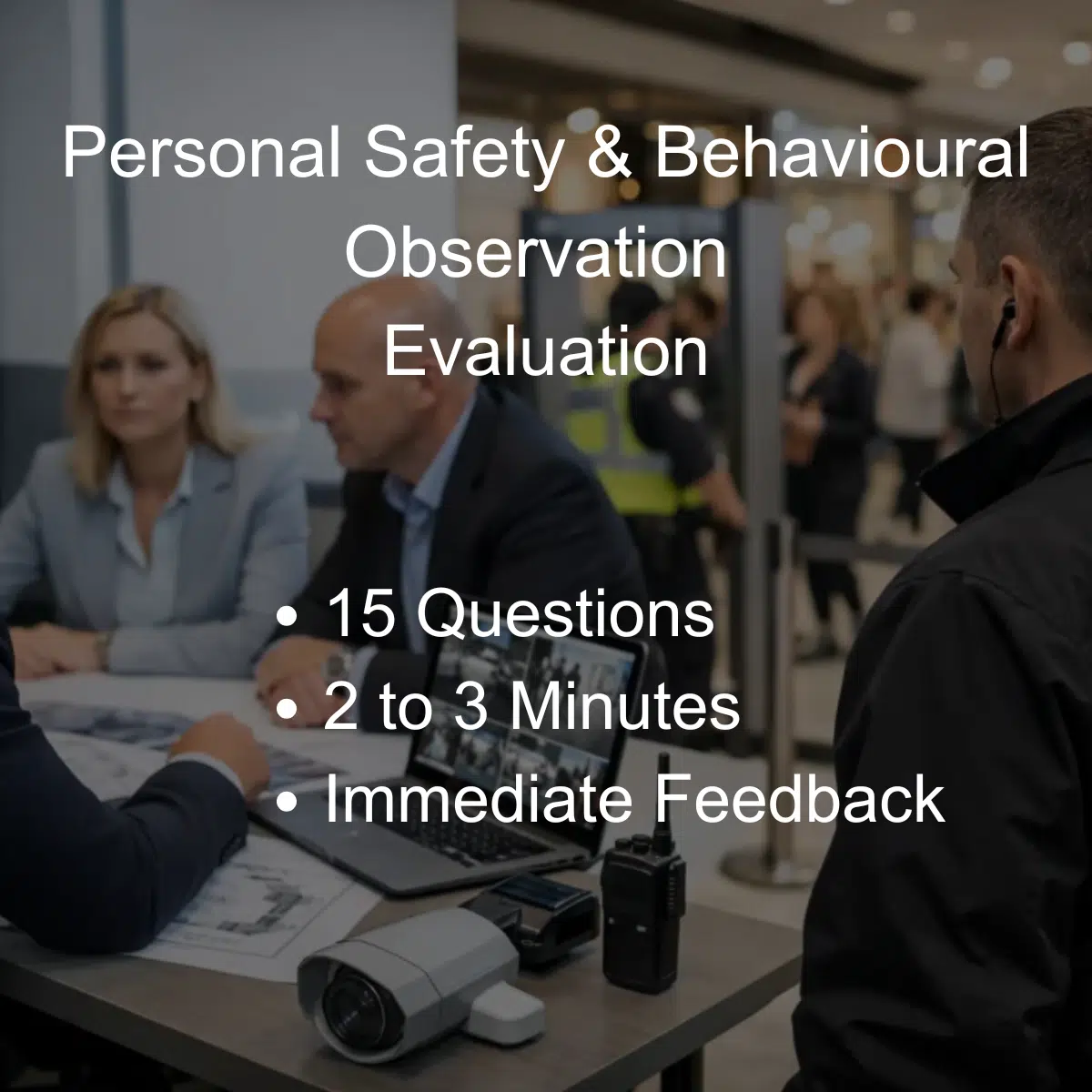
There is also the issue of assessment. If a course only checks recall through simple multiple-choice questions, it may confirm attendance rather than capability. Better assessment tests interpretation, prioritisation, and reporting judgement. Immediate feedback can be particularly valuable because it helps learners understand not just what was wrong, but why.
Finally, some training remains too detached from broader security systems. Behavioural observation should feed into incident reporting, escalation procedures, supervisor oversight, and organisational learning. If the course sits in isolation, its impact will be limited.
What good learners gain from it
When the training is credible, the benefits are tangible.
Frontline staff become more confident in what they are seeing and less likely to ignore weak signals. Supervisors receive better reports because observations are more specific and less emotional. Security teams improve consistency, which matters when multiple people are monitoring the same space across shifts or sites.
There is also a less obvious benefit. Good behavioural observation training sharpens discipline. It encourages staff to slow down mentally, separate fact from assumption, and justify their decisions. In high-pressure settings, that habit has value well beyond one threat type.
For organisations preparing for stronger counter terrorism obligations, including those reviewing readiness under Martyn’s Law, that matters. Compliance may drive the conversation, but capability decides outcomes. Training should not exist simply to show that staff were briefed. It should improve what they notice, how they communicate concern, and what they do next.
How to judge whether a course is worth buying
The quickest way to test value is to ask what changes after completion. If the answer is limited to awareness, it may still have a place as introductory learning, but it should not be mistaken for operational development.
Ask whether the content is built around realistic behavioural indicators rather than stereotypes. Ask whether it addresses hostile reconnaissance, suspicious information gathering, unusual fixation, stress behaviours, and context-driven anomalies in a balanced way. Ask whether learners are taught what not to do as clearly as what to do.
It is also worth looking at whether the training can scale across an organisation without losing relevance. Digital delivery has clear advantages – reach, consistency, speed of deployment, and easier refresh cycles. But scale only helps if the material remains credible to those who work at the sharp end. Experienced operators disengage quickly from content that feels detached from reality.
For that reason, the best providers usually combine training design with actual advisory and assessment experience. They understand that behavioural risk cannot be reduced through eLearning alone. It improves when learning, procedures, leadership, and site-specific context reinforce each other.
Behavioural observation training review for modern threat environments
Modern threats expose old security thinking. Static assumptions, fixed profiles, and tick-box learning do not prepare teams for fluid, ambiguous situations. A useful behavioural observation training review should therefore measure how well a course reflects current operating conditions.
That includes crowded public spaces, mixed-use sites, lone working, high footfall venues, hostile probing through seemingly routine interactions, and the reality that suspicious behaviour may look subtle long before it looks dramatic. It also includes the challenge of decision fatigue. Staff who face constant low-level anomalies need training that helps them stay alert without becoming reactive.
This is where practical, professionally grounded learning has an advantage. It turns theory into action. It helps teams understand why behaviour matters, what patterns deserve attention, and how to respond in a controlled, proportionate way.
Mildot Group’s approach in this space reflects that broader requirement. The value is not in presenting behavioural observation as a standalone trick. The value is in placing it inside wider protective security capability, where training supports judgement, reporting, and performance under pressure.
The trade-off between awareness and competence
Not every organisation needs the same depth. For some teams, a concise awareness-level course is appropriate, especially where staff need a foundation rather than specialist responsibility. For others, particularly those in higher-risk, public-facing, or regulatory-sensitive environments, awareness is only the starting point.
That distinction matters when reviewing training. A short introductory package can still be good if it is honest about its scope. Problems start when low-depth learning is marketed as full capability development. Security leaders should be wary of any course that promises certainty, transformation, or universal applicability with minimal practice.
Competence takes reinforcement. It often requires scenario discussion, local procedures, leadership engagement, and periodic testing. Training should make teams better on shift, not just better at passing a quiz.
The right question is not whether a course is interesting. It is whether your people are more likely to recognise concern early, communicate it clearly, and act within policy when the situation is not straightforward.
That is the standard worth using. Behavioural observation training earns its place when it improves decisions before an incident becomes obvious. If the training cannot do that, it may still inform – but it will not truly strengthen readiness.
Useful Links:
.