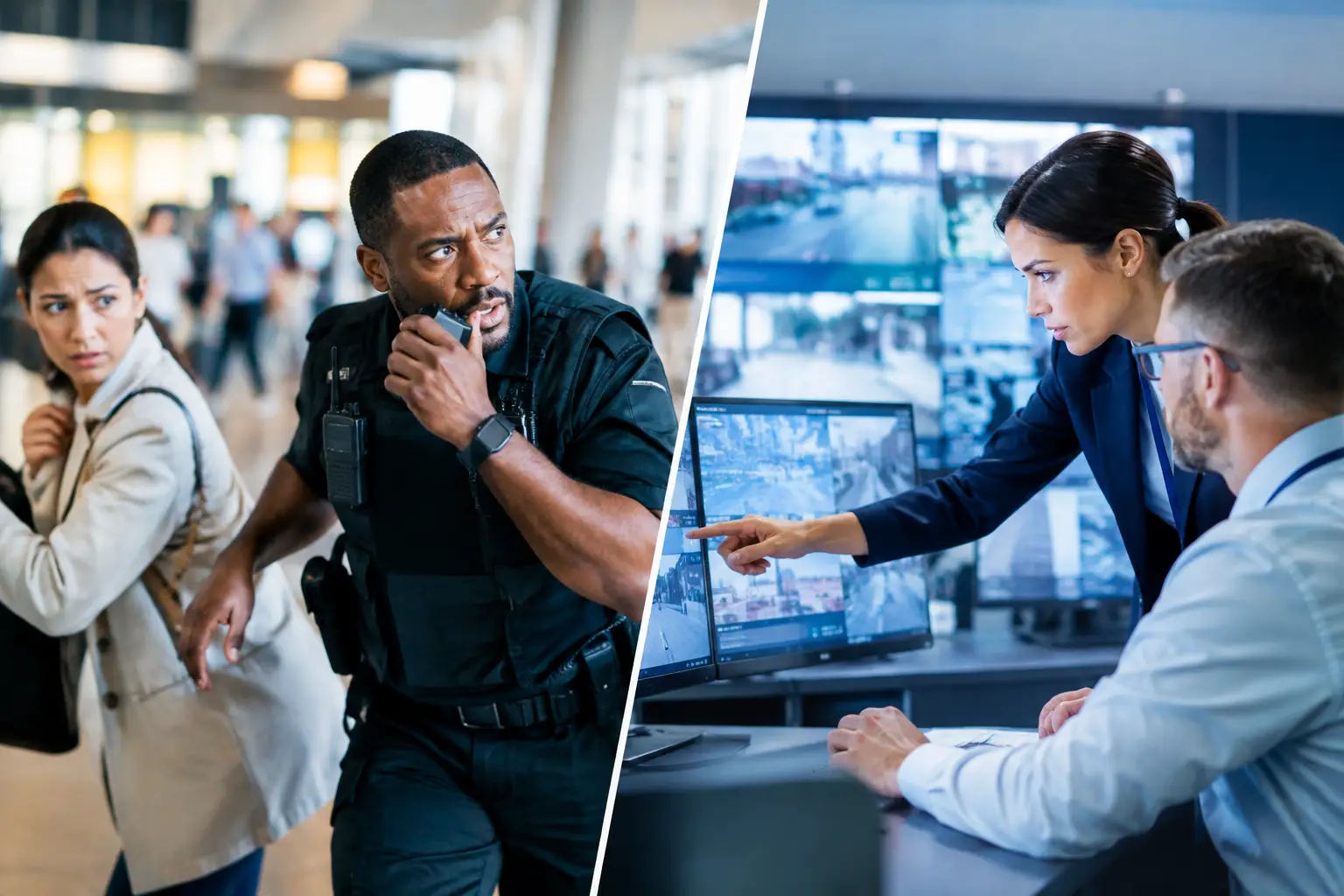
A lost access pass, an unattended contractor laptop and a staff member persuaded to share a one time code may appear to be separate incidents. They are not. Physical security versus cyber security is often discussed as a choice between guarding places and protecting data. In operational reality, both disciplines protect the same organisation from disruption, loss of control and poor decisions under pressure.
The distinction still matters. Treating them as identical creates vague ownership and weak controls. Treating them as separate creates gaps that an incident will eventually expose. The practical task is to understand where each discipline begins, where it overlaps and who is capable of acting when the boundary is crossed.
What physical security is designed to protect
Physical security protects people, premises, assets and the activities taking place within a location. It includes the design and management of access, visitor processes, security officers, surveillance, key control, secure areas, incident reporting and emergency arrangements.
Its central concern is control of the physical environment. Who can enter? Where can they go? What can they take, damage or observe? How quickly will unusual behaviour be recognised, assessed and dealt with? Technology can support those questions, but it cannot answer them alone.
A card reader may show that a door was opened. It does not establish whether the person entering had a legitimate reason to be there, whether they were challenged, or whether a member of staff allowed someone through out of misplaced courtesy. That is why physical security is as much about behaviour, supervision and judgement as it is about barriers and systems.
For organisations preparing for Martyn’s Law, this point has particular weight. Protective security cannot end with a plan or a completed course. People responsible for a site need to recognise concerning behaviour, communicate clearly, make proportionate decisions and lead a response that fits the circumstances.
What cyber security is designed to protect
Cyber security protects systems, networks, devices, information and digital services from unauthorised access, misuse, interruption or compromise. Its work includes identity management, secure configuration, software updates, monitoring, data protection, incident response and user awareness.
The consequences are not limited to stolen information. A cyber incident can interrupt payroll, booking systems, building management, supply chains, communications and critical operational records. A security manager who cannot access a live visitor list during an incident has a physical security problem, even if the cause began in an IT system.
Cyber security also depends heavily on human behaviour. Staff decide whether to report a suspicious email, reuse a password, approve a request without checking it or connect an unknown device. Technical controls reduce the opportunity for error. They do not remove the need for people to notice what is wrong and pause before acting.
This is where organisations often rely too heavily on awareness campaigns. Telling people to be careful is not a control. The useful question is whether staff can recognise the specific pressures they will face in their role, know the reporting route and have confidence that raising a concern will lead to a sensible response.
Physical security versus cyber security: the real difference
The main difference is the environment in which the threat is managed. Physical security deals directly with places, people and visible activity. Cyber security deals primarily with digital identities, information and connected technology. Their specialist knowledge, tools and responsibilities are different for good reason.
Physical teams need to understand site operations, human behaviour, access arrangements, safety considerations and how a location functions at busy or difficult times. Cyber teams need technical knowledge of systems, vulnerabilities, permissions and digital evidence. Neither team can simply absorb the other discipline as an extra task.
The mistake is assuming that specialism requires isolation. A physical security manager may be accountable for contractor access, while IT manages the system that validates identities. Facilities may own the building management platform. Human resources may hold the information needed to remove access when a person leaves. If those functions do not communicate, the organisation has controls on paper but no dependable chain of control.
A useful test is to follow a normal event through its full life cycle. A new starter is issued a device, credentials and building access. A contractor needs access to a restricted area. An employee changes role, works remotely or leaves unexpectedly. Each event contains physical, digital and behavioural decisions. The risk sits in the handovers.
Where the disciplines meet
Connected buildings have made the overlap harder to ignore. Access control, CCTV, alarms, visitor management, heating, lighting and operational systems may all rely on networks, user accounts and third party support. A weakness in their management can become a security issue beyond the IT department.
That does not mean every physical security professional needs to become a cyber specialist. It means they should know enough to ask sound questions. Who administers access permissions? How are changes authorised and reviewed? What happens if the system is unavailable? Is there a workable manual process, and have staff practised it?
The reverse is equally true. Cyber teams should understand the practical effect of taking a system offline, forcing an urgent password reset or changing permissions during an operational period. A technically correct decision can create a safety or security issue if it is made without awareness of what is happening on site.
Insider risk is another meeting point. Most insider concerns do not begin with dramatic intent. They may arise from grievance, financial pressure, poor supervision, weak offboarding, unmanaged access or a culture in which concerns are ignored. Technical monitoring and physical controls can identify signals, but responsible management requires judgement, fairness and clear escalation.
The uncomfortable problem: ownership is usually fragmented
Many organisations have invested in security products but cannot describe how a cross functional incident would be managed. The physical security team has an incident log. IT has a service desk. Facilities has supplier contacts. Senior leaders expect a joined up response, but nobody has tested the joins.
This is not solved by creating another policy. It is solved by defining decision rights and practising realistic scenarios. Who assesses an incident that affects both a site and a system? Who can suspend access? Who informs operational leaders? What information can be shared quickly, and what evidence needs preserving? These questions should be settled before an incident forces hurried judgement.
Tabletop exercises are valuable when they expose friction rather than reward rehearsed answers. A good exercise should reveal missing contact details, conflicting priorities, unclear authority and assumptions about technology. If everyone agrees immediately and the scenario runs perfectly, it has probably tested confidence rather than capability.
Build capability around decisions, not departments
Organisations do not need a single security team that claims expertise in everything. They need capable specialists who understand their dependencies and can work together. Start with the critical activities that must continue: protecting people, maintaining safe access, safeguarding sensitive information, communicating with staff and keeping essential operations functioning.
Then examine the decisions that support those activities. Consider access during system disruption, visitor management when identity checks fail, handling a suspected compromised account held by someone on site, or responding when a key supplier cannot provide support. The aim is not to produce a dramatic scenario. It is to identify what people would actually do in the first hour.
Training should reflect those decisions. Security officers need enough digital awareness to report anomalies without making assumptions. Cyber staff need enough operational context to understand the effect of their actions on a live site. Managers need confidence in escalation, communication and proportionate decision making. Assessment has value when it identifies a real capability gap and directs improvement, not when it simply records attendance.
There is also a commercial case for this approach. Duplication, delayed escalation and poorly managed outages cost money. More significantly, they damage trust in the organisation’s ability to operate. A well written strategy is useful, but it will not compensate for staff who have never practised the decisions the strategy expects them to make.
A more useful question for security leaders
Rather than asking whether physical or cyber security is the greater priority, ask where a failure in one would weaken the other. The answer will differ between a venue, a construction project, a corporate office, a transport operation or critical infrastructure. That is why generic assurance is rarely enough.
Map the dependencies, give people clear authority and test the handovers between teams. The strongest security arrangements are not those with the most controls. They are the ones in which capable people can recognise a problem, share the right information and make sound decisions before a manageable issue becomes an operational failure.