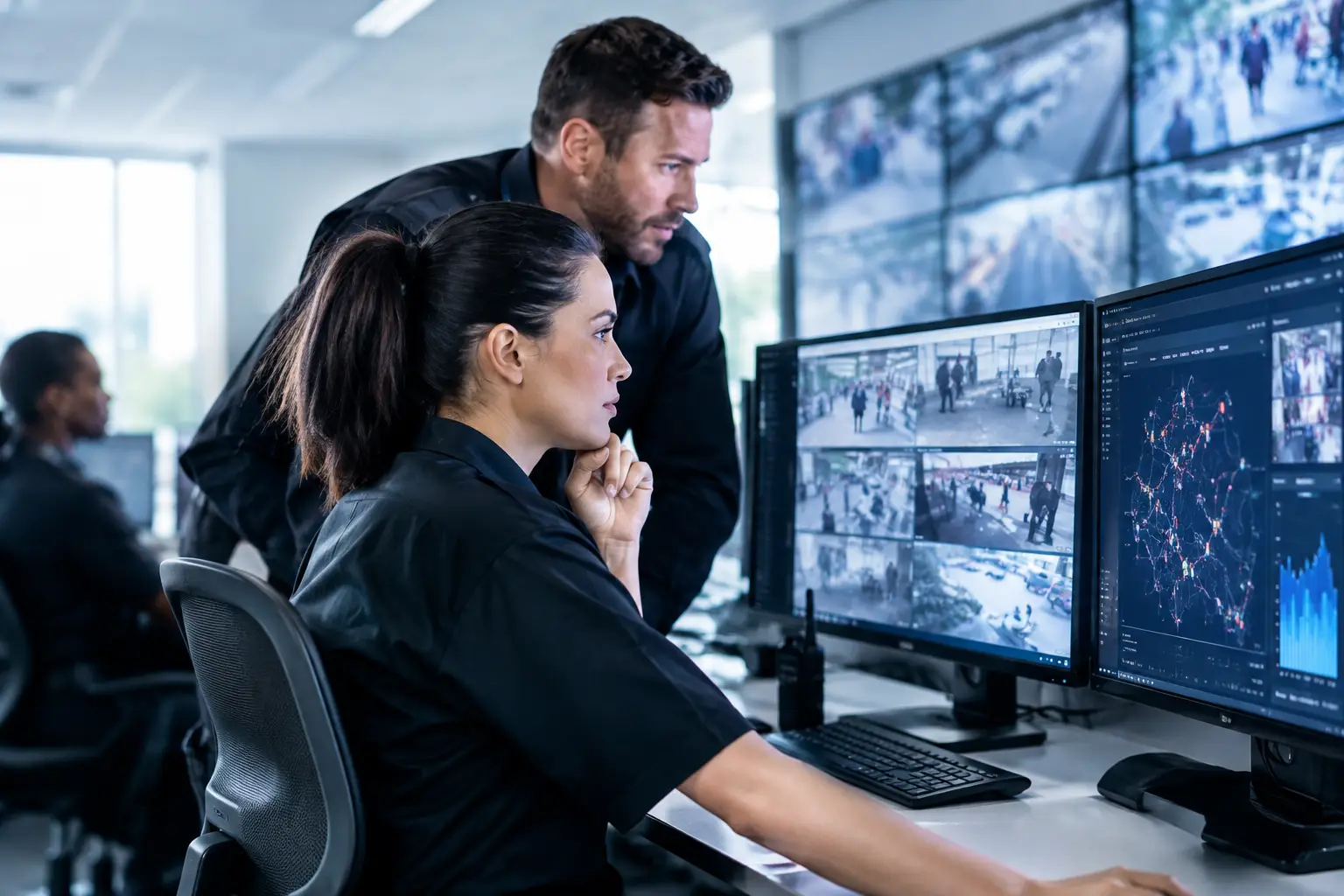
A security control room can look busy and still be ineffective. Screens are monitored, incidents are logged, contractors are present and policies sit in shared folders. Yet when a suspicious package, hostile confrontation, system failure or fast-moving disruption occurs, people may still be unsure who decides, what information matters and how to act. Security operations management is the discipline that closes that gap between having security arrangements and being able to use them under pressure.
It is not primarily an administration function. It is the daily management of people, intelligence, systems, suppliers and response arrangements so that the organisation can identify risk early and make sound decisions when the situation is unclear. That requires more than a control room procedure or a monthly dashboard. It requires operational grip.
Security operations management begins at shift level
The quality of a security operation is often revealed in ordinary moments, not major incidents. Does the shift handover explain what has changed, what needs attention and who owns the next action? Are officers reporting useful observations or merely closing tasks? Does the duty manager understand current vulnerabilities, or only receive a list of completed checks?
Small failures compound. A door fault is left for the next team. A visitor process is bypassed because reception is busy. An emerging behavioural concern is mentioned informally but not recorded or assessed. None may appear serious in isolation. Together, they create the conditions in which a significant issue is missed or mishandled.
Good management sets a clear operating rhythm. Teams need concise briefings that explain the risk picture, not just the task list. Supervisors need to challenge poor standards early and fairly. Escalation routes must work at 0300 as well as they do during normal office hours. This is where policy either becomes capability or remains paperwork.
For sites with public access, events, retail operations, hospitality venues or critical infrastructure, the rhythm must account for changing conditions. Footfall, contractors, weather, public events, industrial action, delivery patterns and local intelligence can all alter the risk picture. A static deployment model may meet a contractual specification while failing to meet the operational need.
Manage decisions, not just activity
A common weakness in security management is measuring what is easy to count. Patrols completed, alarms attended, training delivered and incidents recorded are useful management information. They do not, on their own, tell you whether the operation is effective.
The better question is whether people are making timely, proportionate decisions based on the information available. That means examining the quality of incident reports, supervisor interventions, handovers and escalation decisions. It also means asking whether recurring reports are leading to changes in deployment, process or security design.
Consider repeated access-control alarms at a particular entrance. A weak operation records each alarm, sends an officer and closes the event. A managed operation asks why it is happening. Is the equipment unreliable? Is a contractor using the wrong route? Is the area poorly supervised at a predictable time? Is the response process itself creating delay? The aim is not to produce more data. It is to reduce the source of the risk.
This is why security managers need sufficient authority and visibility. If the operation can identify a weakness but cannot influence estates, IT, HR, procurement or senior leadership, it becomes a reporting service rather than a security function. Effective management connects security intelligence to the people who can act on it.
Define authority before pressure does it for you
Many organisations have escalation charts but no genuine clarity about decision-making authority. Staff know they should escalate an issue, but they do not know who can stop an event, restrict access, call for specialist support or communicate with senior leaders. Delay follows because people wait for permission that should have been pre-agreed.
Authority should be proportionate to role, risk and competence. A front-line officer does not need authority to make strategic decisions. They do need enough clarity to protect life, preserve safety, report concerns and initiate immediate site procedures without hesitation. Supervisors need defined thresholds for increasing resources or changing local controls. Senior leaders need to understand what decisions only they can make and how they will receive reliable advice.
This is particularly relevant when preparing for Martyn’s Law. Compliance activity may establish duties and records, but operational readiness depends on people being able to recognise concerns, communicate clearly and respond in line with their role. The document does not make the decision. The person does.
Capability is the real control
Security teams are often assessed by headcount, licences, response times and visible presence. These matter, but they are not the full picture. Two teams with identical staffing numbers can perform very differently because one has better leadership, clearer standards and more realistic development.
Capability includes situational awareness, communication, judgement, confidence with procedures and the ability to remain effective when information is incomplete. It includes knowing when an issue can be resolved locally and when it needs escalation. It also includes the discipline to report facts rather than assumptions.
Training has a role, but attendance is not evidence of competence. A person can complete an eLearning module and still struggle to apply its content during a crowded, confusing or emotionally charged situation. Training should therefore be supported by practical discussion, scenario-based assessment, observed performance and feedback that identifies specific gaps.
A useful development conversation does not ask, “Have you completed the course?” It asks, “What would you do differently if this occurred on your next shift?” The answer reveals whether learning has transferred into operational judgement.
Mildot Group’s approach to capability diagnostics reflects this distinction. Immediate feedback is valuable when it shows practitioners where their reasoning, knowledge or response priorities need improvement. Used properly, it directs development effort towards the gaps that matter rather than creating another completion record.
Technology should support judgement
Security technology can improve coverage, speed and evidence quality. It can also create false confidence. A system is only a control when somebody understands its purpose, limitations and response requirements.
CCTV is a clear example. Cameras may provide excellent visibility, but images have limited protective value if operators are not trained to recognise relevant behaviour, prioritise observations and communicate accurate information. Likewise, access control can restrict movement, but it cannot resolve poor visitor management, tailgating tolerance or inconsistent contractor processes.
The management task is to link technology to an operating procedure. Who monitors it? What prompts action? Who verifies faults? How are recurring issues analysed? What happens when the system is unavailable? These questions should be answered in routines, exercises and shift briefings, not discovered during an incident.
There is a trade-off. More technology can produce more alerts, more complexity and more opportunities for staff to disengage. Organisations should not buy systems to compensate for weak supervision or unclear processes. First establish the operational requirement. Then select technology that supports it.
Test the operation honestly
Tabletop exercises, drills and assurance checks can be valuable, but only if they test how the organisation really works. Exercises that follow a polished script and produce predictable answers are reassuring rather than useful.
A credible test introduces realistic uncertainty. A key decision-maker may be unavailable. Communications may be incomplete. A contractor may not understand the site procedure. The situation may develop outside normal hours. The purpose is not to catch people out. It is to expose assumptions before a real event does.
Afterwards, avoid the vague finding that “communications could be improved”. Identify the failure precisely. Was the contact list wrong? Did the supervisor fail to provide a clear briefing? Did staff use inconsistent terminology? Did nobody own the next action? Specific findings lead to specific improvements.
The same applies to incident reviews. Do not focus only on whether the final outcome was acceptable. A positive outcome can result from luck, experienced individuals or circumstances that will not be repeated. Review the decisions, information flow, controls and behaviour that produced it. Then decide what should change.
The management standard worth aiming for
The strongest security operations are not those with the most imposing documentation or the greatest volume of reporting. They are the operations where people understand the threat picture, know their role, challenge deterioration early and make sensible decisions without waiting for a crisis to tell them what matters.
If you want an honest measure of your operation, look beyond the policy suite. Listen to a handover, read a sample of incident reports, watch how supervisors brief their teams and ask staff what they would do if normal arrangements failed. Their answers will show whether your security operation is being managed, or merely administered.