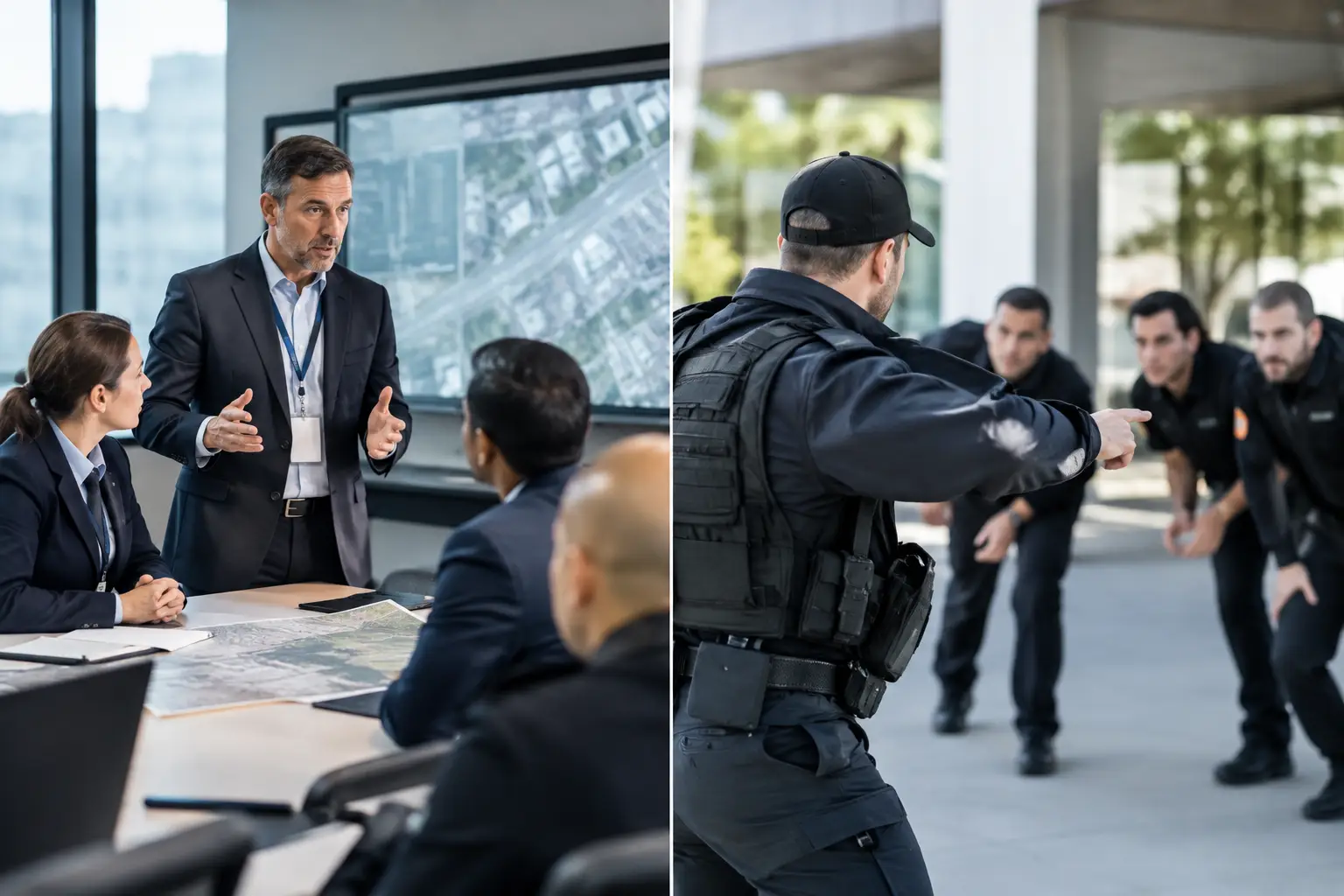
A plan can look credible at 09:00 in a meeting room and fail by lunchtime when information is incomplete, a key supplier cannot respond and the person expected to lead is unavailable. A corporate resilience review is valuable when it examines that gap. Its purpose is not to confirm that policies exist. It is to establish whether people, systems and decisions can protect critical activity when normal operating conditions are lost.
For security leaders and senior decision makers, that distinction matters. Disruption rarely arrives in the tidy form assumed by a procedure. It creates competing priorities, uncertainty, pressure from customers and staff, and decisions that cannot wait for a full picture. A review that only samples documents will miss the conditions most likely to expose the organisation.
What a corporate resilience review should examine
Resilience is often treated as another name for business continuity. Continuity arrangements are part of it, but they are not the whole picture. Corporate resilience concerns the organisation’s capacity to anticipate disruption, absorb its immediate effects, make sound decisions, adapt operations and recover without creating further harm.
That requires an assessment across several connected areas: leadership and governance, protective security, crisis arrangements, operational dependencies, communications, workforce behaviour, technology, suppliers and recovery priorities. The exact emphasis depends on the organisation. A venue managing crowded spaces has different concerns from a construction business reliant on mobile teams, or a corporate operation dependent on data, facilities and specialist third parties.
The review should begin with critical outcomes, not a catalogue of plans. What must the organisation continue to do? Which services, decisions or assets cannot be allowed to fail? Who depends on them, and what is the realistic consequence if they are interrupted for an hour, a day or longer?
This approach prevents a common error: treating every function as equally important. Resources are finite. Senior leaders need a defensible view of what receives protection first, what can be paused and what conditions trigger escalation.
The difference between coverage and capability
A business may have incident plans, evacuation procedures, emergency contact lists, security measures and supplier contracts. That is coverage. Capability is different. It is shown when the right people can find and interpret the information, recognise when a situation has changed, act within their authority and communicate clearly with those affected.
A useful review therefore asks questions that documents alone cannot answer. Would duty managers know which decision sits with them? Can teams account for people, assets or operational status quickly enough? Are contact lists maintained by someone who understands their importance? Does the crisis team know how it will work if its preferred systems are unavailable?
These are not trick questions. They identify whether resilience is embedded in the way the organisation operates, or stored in a folder for assurance purposes.
Review the decisions, not only the plans
The most revealing part of a corporate resilience review is often a structured examination of decisions under pressure. Rather than asking whether a plan contains an escalation process, assess how escalation would actually happen.
Take a plausible disruption affecting a major site, key system or critical supplier. The scenario does not need dramatic detail. It needs enough operational realism to force prioritisation. Information should be incomplete at first, because that is usually the reality. Participants should explain what they would do, who they would involve, what they need to know and what they would communicate.
Observe the decision points. Is there a shared understanding of the immediate objective? Do people know the limits of their authority? Is the response slowed by a need to seek approval from someone who cannot be reached? Are security, operations, communications and people teams working from the same picture?
The purpose is not to catch individuals out. It is to expose friction in the system before a live event exposes it publicly. Where a person lacks knowledge, the remedy may be targeted development. Where several capable people reach different conclusions, the issue may be unclear governance, conflicting plans or poorly defined priorities.
Test the handovers that create risk
Many failures occur at organisational boundaries. Security may identify a developing concern but lack a clear route to operational leaders. An incident manager may focus on site recovery while a communications team prepares messages without confirmed facts. Procurement may understand a supplier dependency that was not considered in the continuity plan.
These handovers deserve close attention because no single function owns them. A good review traces how information moves between teams, what information is required at each stage and who has the authority to make the next decision. It also considers shift changes, absence, remote working and out-of-hours arrangements.
An organisation that performs well only when its most experienced people are present is not yet resilient. It is dependent on individual effort. Experienced people remain vital, but resilience requires their judgement to be supported by clear roles, usable information and rehearsed ways of working.
Examine assumptions before they become dependencies
Most resilience weaknesses begin as untested assumptions. A supplier will answer. Staff will receive messages. A secondary location will be available. A system can be restored within the required period. The executive team will be together when a decision is needed.
Some assumptions will be reasonable. The risk lies in leaving them unexamined. The review should identify those that underpin critical activity and seek evidence that they hold true. This might involve checking arrangements with suppliers, validating recovery information, speaking to operational teams or observing how normal reporting and escalation operate.
Evidence has to be proportionate. A small organisation will not need the same review depth as a complex multi-site operation. Equally, a business with high public footfall, regulated services, critical infrastructure links or a developing Martyn’s Law duty should avoid a superficial annual exercise. The consequence of poor judgement may be far greater than the inconvenience of testing arrangements properly.
It is also sensible to distinguish between a single-point dependency and a genuine fallback. A second supplier is not automatically a fallback if it uses the same distribution route, technology platform or specialist labour pool. A deputy is not a resilience measure if they have never been briefed, trained or given access to the relevant information.
Build findings around operational priorities
The output of a review should not be a long register of observations with identical urgency. It should give leaders a clear route from weakness to action.
Findings are best grouped by their operational effect. For example, some issues will prevent a timely life-safety, security or crisis decision. Others may undermine communications, delay recovery or create an avoidable financial and reputational cost. Each needs an owner, a realistic corrective action and a way to determine whether the improvement has worked.
The highest priorities commonly involve unclear command arrangements, poor access to accurate information, fragile communications, untested dependencies and teams asked to make decisions beyond their preparation. These matters cannot be solved by issuing another policy. They require practical changes such as role-based exercises, revised decision thresholds, better incident information, supplier engagement or focused competence development.
Measures should reflect performance, not activity. Counting completed training or signed documents may be useful administration, but it does not establish readiness. More meaningful indicators include the time taken to form a decision-making group, the quality of information available to it, whether teams can carry out their assigned roles and whether corrective actions remain effective after staff or operating conditions change.
Make resilience a managed operating discipline
A corporate resilience review should be a starting point for a cycle of improvement, not a one-off assurance event. Major organisational changes should prompt fresh scrutiny: a new site, altered operating hours, outsourcing, technology migration, merger, key personnel change or a change in threat profile. Smaller changes can combine into a significant vulnerability when nobody considers their cumulative effect.
There is a balance to strike. Constant exercises can become performative and drain operational time. Reviews that are too infrequent allow assumptions to harden unchecked. The right rhythm depends on risk, complexity and the pace of change. What matters is that testing is purposeful and that lessons lead to visible improvement.
Mildot Group’s practical approach to resilience reflects this principle: theory has value only when it improves judgement and action in real conditions. The organisation does not need perfect foresight. It needs leaders and teams who can recognise what matters, act on reliable priorities and adapt when the first plan no longer fits the situation.
The question worth taking back to the next leadership meeting is simple: if normal operations stopped without warning, would your people know what to protect first, who can decide and how they will prove the response is working?