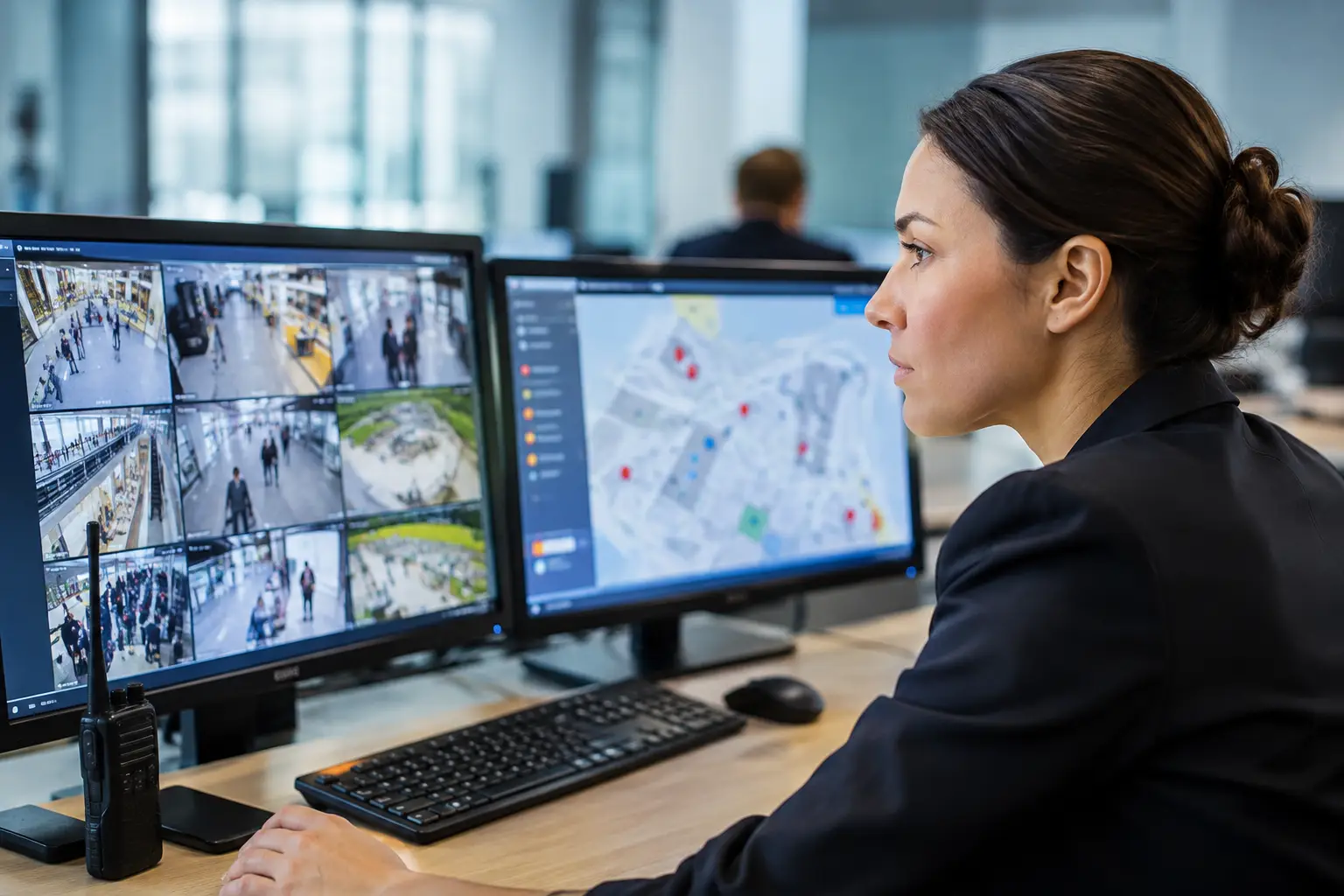
A busy concourse, hotel lobby or retail floor produces constant movement, distraction and noise.
The best behavioural observation techniques help security and staff separate ordinary activity from behaviour that may require attention, engagement or escalation.
They do not rely on instinct alone.
They give people a disciplined way to notice change, assess context and act early.
Behavioural observation is not about identifying a particular type of person.
It is about recognising actions, indicators and patterns that are out of place for the environment. Done properly, it supports proportionate decisions, protects the public and gives frontline staff the confidence to report concerns without overreacting.
Why observation must be more than vigilance
Most teams understand the instruction to remain vigilant.
The weakness is that vigilance is often left undefined. A member of staff may be alert throughout a shift yet lack a clear method for deciding what matters, what to record and when to involve others.
Modern threats expose old security thinking.
A visible presence and a written procedure are useful, but neither guarantees that people can identify pre-attack planning, hostile reconnaissance or a developing incident.
Capability comes from repeated practice in observing, communicating and making sound decisions.
The aim is not to turn staff into intelligence analysts.
It is to help them identify behaviour that is inconsistent with the setting, then apply an agreed reporting and response process.
A concern may prove innocent.
That does not make the observation poor.
It means the process has worked as intended.
Best behavioural observation techniques in practice
The most effective approach combines several simple techniques.
Each is useful on its own, but together they create a stronger and more defensible assessment.
Establish what normal looks like
A baseline is the starting point for credible observation.
Teams need to understand the normal rhythm of their site, where visitors enter, how queues form, when deliveries arrive, what staff movement looks like and which areas draw legitimate public interest.
Normal is not fixed.
The baseline changes by time, season, event schedule and local conditions.
A person standing near an entrance may be entirely ordinary during a venue opening, but the same behaviour could warrant closer attention if the building is closed or access is restricted.
Briefings should identify current vulnerabilities and expected activity.
This gives staff a practical reference point rather than asking them to rely on a vague feeling that something is wrong.
Look for behaviour in context
Single indicators rarely tell the full story.
Anxiety, hesitation, unusual clothing or repeated movement may have entirely innocent explanations.
Effective observers consider what a person is doing, where they are doing it, how long it has continued and whether their actions make sense for that environment.
For example, someone studying entry points, cameras and staff routines over time may warrant attention, particularly if they repeatedly avoid normal visitor routes.
By contrast, a guest looking for reception, a parent managing children or a contractor waiting for access may appear unsettled but be acting for understandable reasons.
This context led approach reduces bias.
It keeps attention on observable conduct rather than appearance, identity, accent, religion, ethnicity, age or other personal characteristics.
That is both operationally sound and essential for fair treatment.
Identify clusters and changes
A useful principle is to look for clusters, not isolated signs.
Several small deviations may form a more meaningful picture when they occur together. Repeated reconnaissance, unusual interest in security arrangements, attempts to access unauthorised areas, concealment activity, testing staff responses or leaving an item unattended can become significant when assessed as a pattern.
Change is equally important.
A visitor who becomes agitated after being challenged, changes direction when approached, or repeatedly returns to the same location may require a measured response.
Teams should avoid assigning motives too quickly.
The objective is to recognise that the behaviour has changed, preserve the facts and decide what action is proportionate.
Use purposeful engagement
Respectful engagement is one of the strongest behavioural observation tools available.
A simple, professional conversation can clarify purpose, deter hostile activity and provide further information without creating unnecessary confrontation.
Good engagement is calm and direct.
Ask open but relevant questions, listen to the response and observe whether it matches the situation.
A legitimate visitor can usually explain where they are going or who they are meeting. An unclear, contradictory or evasive response does not prove malicious intent, but it may justify further checks or escalation.
Staff should not conduct an improvised interrogation.
They should work within their role, follow site procedures and call for support when needed.
Safety, service and control must remain balanced.
Observe without becoming predictable
Static observation points have value, but predictable routines create gaps.
Teams should vary patrol timing, approach routes and the way they monitor vulnerable areas, while maintaining clear accountability. This is particularly relevant at events, transport adjacent locations, crowded retail sites and hospitality venues where hostile reconnaissance can blend into normal public behaviour.
Discreet observation must still be lawful, proportionate and aligned with organisational policy.
The purpose is to improve awareness, not to create an atmosphere of suspicion.
Turn observations into useful reports
An observation only improves security if it reaches the right person in a form they can use.
Reports based on assumptions – such as looked suspicious – provide little operational value.
Reports based on facts support better decisions.
Teams should capture the specific behaviour observed, the location, time, direction of travel, relevant descriptions, any vehicles or items involved, and the action already taken.
Where possible, distinguish clearly between fact and judgement. Individual photographed the loading bay entrance twice between 14:10 and 14:20 is stronger than individual was casing the site.
A clear report also enables supervisors to identify repeat activity across shifts, sites or departments.
The person who notices an unusual interaction may not hold the full picture. A proper reporting chain allows separate observations to be assessed together.
Make escalation thresholds clear
Frontline staff should not have to guess whether to report a concern.
Organisations need simple thresholds that explain when to log, when to notify a supervisor, when to involve control room functions and when to contact emergency services.
The response must match the risk.
Some matters require no more than a courteous conversation and a record.
Others may require observation from a safe distance, access control action, preservation of CCTV evidence or immediate emergency escalation.
Training should test these decisions through realistic scenarios, not only slides and policy acknowledgements.
Build observation capability through practice
Behavioural observation is a perishable skill.
A one off briefing may increase awareness for a short period, but it does not reliably improve decision-making during a crowded, fast-moving incident.
Teams need structured learning, reinforcement and feedback.
Effective development combines short learning modules with scenario led discussion, practical assessments and post incident review.
Staff should be given examples relevant to their site and role.
A hotel team needs to understand public areas, service corridors and event functions.
A retail team may need to focus on entrances, stock areas, suspicious packages and crowd behaviour. Critical infrastructure teams require a deeper understanding of access, process vulnerability and insider risk.
Assessment matters because attendance is not competence. Capability evaluation can reveal whether personnel can recognise behavioural indicators, select an appropriate response and report accurately.
This turns theory into action and identifies where additional coaching is needed before a real incident exposes the weakness.
Leaders also have a role.
If staff are criticised for raising proportionate concerns that turn out to be innocent, reporting will fall away.
If every minor concern is treated as a crisis, confidence and public trust will suffer.
The right culture rewards accurate observation, professional curiosity and disciplined decision-making.
The limits of behavioural observation
Behavioural observation can reduce risk, but it is not a guarantee and it should never be presented as one.
Some hostile actors will display few visible indicators.
Equally, innocent people may act nervously, appear confused or behave unusually because of stress, disability, language barriers or personal circumstances.
That is why observation must sit within a wider protective security plan.
Physical security measures, access controls, trained staff, incident communications, emergency procedures and informed leadership all contribute to resilience.
Behavioural techniques add value by helping people see and communicate what systems alone may miss.
The strongest teams do not claim they can predict intent.
They create the conditions to spot concerning behaviour early, engage professionally, report facts clearly and respond with control.
That is the practical standard that strengthens readiness when it matters.
.
Useful Links:
.