A site can pass an audit in the morning and still fail under pressure that same afternoon. That is the central issue in capability evaluation versus compliance audit. One tells you whether required controls, records and processes appear to be in place. The other tests whether people, plans and decision-making can actually perform when threat conditions change, time compresses and consequences become real.
For organisations facing elevated terrorism and protective security risk, that distinction matters. Retail, events, hospitality, infrastructure and corporate environments do not need paperwork that looks tidy but collapses at the point of use. They need evidence that security arrangements work in practice, with real people, in real operating conditions.
What capability evaluation versus compliance audit really means
A compliance audit is designed to measure alignment against a rule set, standard, policy or legal requirement. It asks whether the organisation has done what it said it would do, or what it is expected to do. That might include procedures, training records, governance structures, contractor controls, maintenance logs, risk registers or incident reporting arrangements.
That has value. If a legal duty applies, compliance cannot be treated as optional. If policies are absent, expired or ignored, that signals exposure. Audits also help leaders identify gaps in governance and demonstrate due diligence.
But a capability evaluation asks a different question. It looks beyond whether a measure exists and examines whether it can deliver the required effect. It tests operational credibility. Can teams detect hostile behaviour early enough? Can supervisors escalate concerns without delay? Can managers make sound decisions with incomplete information? Can an evacuation, lockdown or shelter plan be executed under stress, in a crowded venue, on a poor communications day?
This is why capability evaluation versus compliance audit should never be reduced to a semantic debate. One is largely about conformance. The other is about performance.
Why compliance alone creates false confidence
Many organisations fall into a predictable trap. They commission policies, complete mandatory training, file the evidence and assume their exposure has reduced. In governance terms, progress has been made. In operational terms, perhaps not.
Modern threats expose old security thinking. Attackers do not care whether your documents are formatted correctly or whether an audit trail looks complete. They exploit hesitation, confusion, poor supervision, weak reporting culture and untested plans. A compliance audit may confirm that a response procedure exists. It will not automatically show whether frontline staff understand it, trust it or can apply it under pressure.
This is where false confidence becomes dangerous. Senior leaders see green indicators. Teams assume readiness. Then a real incident exposes friction points that no one had properly tested – overloaded control rooms, vague thresholds for escalation, role confusion, poor handover discipline, or training that was completed but never embedded.
In protective security and counter terrorism, that void is not academic. It is where risk lives.
Where a compliance audit still matters
None of this means audits are unhelpful. They are necessary in several contexts.
If your organisation is working to defined legal obligations, industry standards, insurer expectations or client requirements, a compliance audit provides structure and evidence. It can identify whether essential foundations are missing. It can also help assure boards and regulators that responsibilities are being taken seriously.
For organisations preparing for increased scrutiny under UK protective security requirements, audit discipline can strengthen accountability. It can force ownership of policy, clarify reporting lines and reveal whether risk treatment actions have actually been completed.
The limitation is that compliance evidence is only one layer of assurance. It tells you whether the architecture exists. It does not prove the building will stand in a storm.
It’s a purely theoretical assessment.
What a strong capability evaluation looks like
A serious capability evaluation is not a box-ticking exercise with different branding. It is designed to expose whether security theory has been turned into action.
That usually means assessing individuals, teams and management arrangements against realistic demands. Not abstract best practice, but the actual pressures your environment is likely to generate. In a venue setting, that may include hostile reconnaissance, suspicious item response, crowd movement challenges and decision-making during partial information. In a corporate or infrastructure setting, it may include escalation thresholds, interdepartmental coordination, protective intelligence use and command continuity.
Good evaluation looks at more than knowledge. It examines judgement, role clarity, communication quality and the organisation’s ability to adapt. A person may know the correct answer in a classroom and still fail to act decisively when there is ambiguity, social pressure or fear of being wrong.
That is why scenario-based diagnostics are useful. They show whether people can interpret indicators, prioritise actions and make defensible decisions at operational speed. They also generate a better development picture. Instead of simply stating that training has been completed, leaders can see where capability is strong, where it is inconsistent and where intervention is needed.
Capability evaluation versus compliance audit in practice
The practical difference becomes clear when you compare the outputs.
A compliance audit often ends with findings such as missing records, outdated policies, incomplete drills or unclear governance ownership. Those are legitimate findings. They can and should be corrected.
A capability evaluation, by contrast, may reveal that teams hesitate to challenge suspicious behaviour, managers misunderstand lockdown triggers, incident logs are too slow to support live decision-making, or contractors do not integrate cleanly into response arrangements. Those findings are harder, but they are closer to the truth of operational readiness.
This is also where capability work becomes commercially useful. It does not just identify what is absent. It shows what to improve first. Leaders can target investment at performance-critical weaknesses rather than spreading time and budget thinly across every visible gap.
In high-risk sectors, that prioritisation matters. Security teams are often expected to do more with finite resources. An audit can produce a long action list. A capability evaluation helps distinguish between administrative imperfections and weaknesses that could materially degrade response.
The strongest security programmes use both
The choice is not always either-or. In mature organisations, capability evaluation versus compliance audit should be treated as a sequencing question, not a rivalry.
Compliance gives you the baseline. It establishes whether required structures, duties and documented controls are in place. Capability evaluation then tests whether those arrangements can perform under realistic conditions.
If you start with capability and discover that policies, responsibilities or legal controls are absent, you may be building on weak foundations. If you stop at compliance, you risk mistaking documentation for readiness. The most effective approach is layered assurance – first confirm the basics exist, then test whether they work.
That balance will vary by organisation. A business at an early stage of maturity may need to stabilise governance first. A more developed operation, especially one with elevated public exposure, may gain far more value from capability diagnostics, realistic exercises and targeted development for supervisors and decision-makers.
What buyers should ask before commissioning either
If you are selecting external support, the key question is simple: what decision will this piece of work help you make?
If you need evidence of conformity against a requirement, commission an audit. If you need to know whether your people and systems can perform under pressure, commission a capability evaluation. If you need both, be explicit about that from the outset.
You should also ask how realism will be built into the assessment. Generic checklists rarely expose meaningful weaknesses in dynamic environments. The better method is one shaped around threat profile, operating model, crowd or site realities, leadership structure and likely pressure points.
This is where specialist security consultancies with operational depth add value. They understand that readiness is not created by templates. It is built through credible assessment, targeted learning and feedback that teams can actually use. Mildot Group’s approach reflects that principle by treating resilience as a function of capability, not paperwork.
The better question is not are we compliant
Boards often ask, are we compliant? It is a fair question, but it is not the one that decides outcomes on the day. The harder question is, can we perform when the environment becomes confused, fast and unforgiving?
That is the real test. Compliance may protect the organisation from preventable governance failure. Capability protects it from operational failure. You need both, but they are not equal in purpose.
If your security arrangements look good on paper yet remain untested in practice, the next step is clear. Measure what your teams can actually do, not just what your files say they should do. That is where meaningful resilience begins.
The worst time to realise your organisations capability is poor is during an incident. The best time is long before an incident and using 21st century systems to improve it.
Evaluation Options
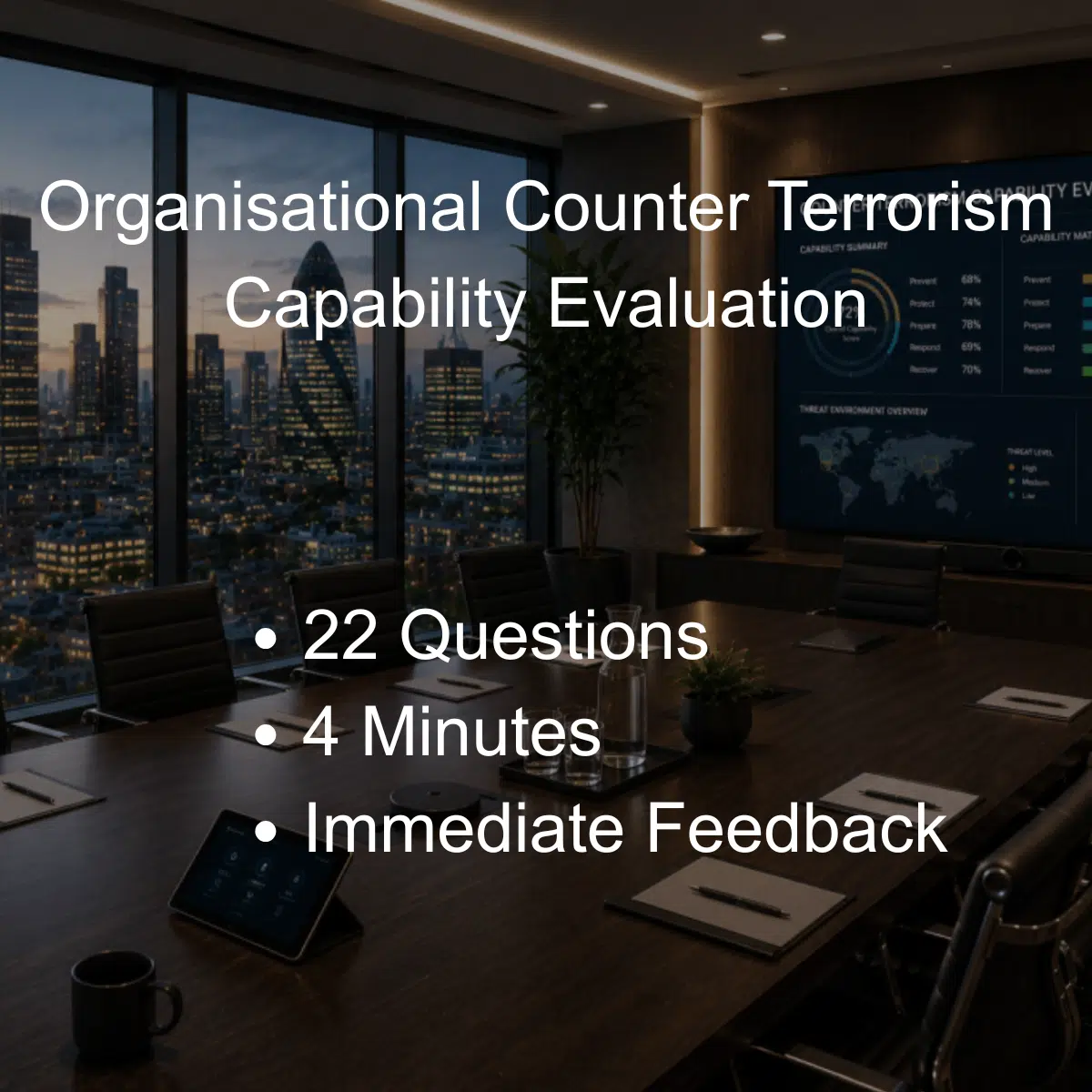
Mildot Group Online Platform – Takes 4 minutes. Immediate feedback.
Quick Assessment Questions on site – Takes 5 minutes.
Short on site exercises – 15 to 30 minutes.
.