A person can complete every required security module, understand the reporting process and still make a poor decision when something does not look right.
That space between knowing and doing is where the future of behavioural risk assessment matters most.
It is not about finding a perfect score for human behaviour. It is about giving organisations a more credible view of how people notice, interpret, communicate and act when pressure rises.
For protective security, counter terrorism and crisis management teams, this is a material issue.
Policies describe what should happen. Behavioural assessment shows whether people are likely to make it happen.
The difference can determine whether an early concern is identified, reported properly and managed before it becomes a more serious problem.
The future of behavioural risk assessment is capability
Behavioural risk assessment has often been treated too narrowly.
It has been reduced to personality questionnaires, generic wellbeing indicators or retrospective investigations after an incident.
Those tools may have value in the right context, but they do not provide a complete operational picture.
A useful assessment considers behaviour in relation to a task, environment and decision. Can a duty manager distinguish an unusual circumstance from normal operational noise? Will a front-of-house colleague challenge respectfully when access arrangements appear wrong? Does a project team raise an emerging risk early, or wait until the issue is difficult to contain?
These are practical questions, not abstract ones.
The future lies in assessing capability as it is applied. That means looking beyond self reported confidence and course completion. People generally rate themselves well when the question is broad and consequence-free.
Their judgement becomes clearer when they must interpret information, prioritise competing demands and explain what they would do next.
This should not be confused with trying to predict misconduct or identify a single type of risky person.
Behaviour changes with workload, leadership, local culture, fatigue, unclear authority and perceived consequences.
An experienced employee can make a poor call in an environment that discourages challenge.
A less experienced colleague may perform well when expectations are clear and support is available.
Better evidence, not more surveillance
Technology will shape behavioural assessment, but it will also create risks of its own.
Organisations can now collect large volumes of data about learning activity, access patterns, performance and communication. More data does not automatically mean better judgement.
A system can show that someone opened a training module, passed a knowledge check or acknowledged a procedure. It cannot, without proper design and human interpretation, show whether they can recognise a developing concern in a live environment. Nor can it reliably explain why performance changed.
The temptation will be to use automated scoring as a shortcut.
That approach should be treated cautiously. A score can support a decision, identify areas for further review or reveal a trend across a team. It should not become a substitute for professional judgement, especially where the result could affect a person’s role, reputation or opportunity.
The strongest use of technology is diagnostic.
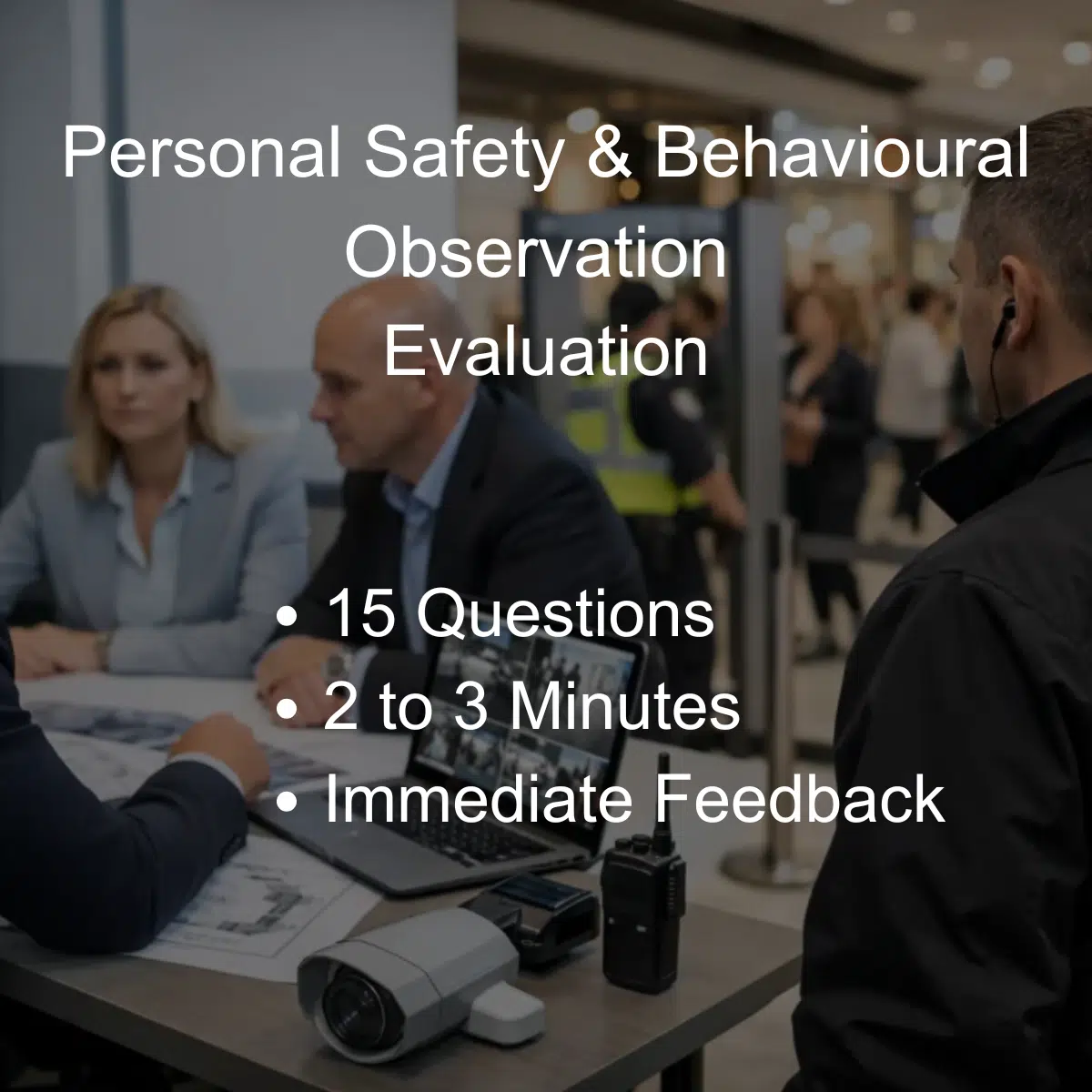
Scenario based evaluations can test how people interpret uncertain information and select a proportionate response. Immediate feedback can expose a misunderstanding while it can still be corrected.
Organisational reporting can show where capability is uneven, where leaders need to intervene and where training has not translated into operational confidence.
That is more valuable than a pass mark. A pass mark is often an administrative endpoint.
A diagnostic should be the start of improvement.
Behaviour must be assessed in context
A security officer working at a busy venue, a facilities manager overseeing contractors and a project manager handling a pressured delivery programme face different behavioural risks. Even where the underlying principles are shared, the context changes the decision.
Consider situational awareness. In a quiet corporate reception, an unfamiliar person seeking entry may be easy to notice.
In a crowded transport setting or during an event changeover, the same concern can be masked by pace, distraction and competing demands. The relevant question is not simply whether a person knows the access control policy. It is whether they can apply it calmly, communicate with others and escalate without causing unnecessary disruption.
This is why generic behavioural profiles are of limited use for operational risk.
They can create a false sense of precision while missing the pressures that shape real conduct. Assessment needs to reflect the working environment, authority levels, available information and consequences of delay.
It also needs to test judgement under ambiguity.
Most significant decisions are not made when every fact is known. They are made when something is incomplete, unusual or contradictory.
People need enough confidence to act, alongside enough discipline to avoid overreaction.
The real weakness is often the team, not the individual
Organisations commonly assess individuals while overlooking the conditions created by the team.
Yet many failures in security and crisis response are collective. A concern is noticed but not shared. A report is made but not owned. A junior colleague sees a problem but assumes a manager has already dealt with it.
A manager receives incomplete information and does not ask the next question.
Behavioural risk assessment should therefore examine handovers, escalation routes, challenge, leadership and decision ownership. It should look at whether people understand who has authority to act and whether that authority works in practice.
This matters particularly for organisations preparing for Martyn’s Law. Plans, training records and documented roles are necessary, but they are not proof that a team can respond effectively. Staff must be able to recognise relevant concerns, communicate quickly, make sensible decisions within their role and support the wider response.
Those capabilities need to be exercised and assessed, not assumed.
Leaders have a direct influence here. Teams take their cue from what leaders reward and tolerate. If every report is treated as an inconvenience, reporting will decline. If people are criticised for escalating a concern that later proves harmless, they will hesitate next time. A mature security culture accepts that proportionate reporting will occasionally produce false alarms.
That is the cost of early intervention, not evidence of failure.
Assessment should lead to a specific intervention
An assessment that merely labels people as low, medium or high risk has limited operational value. The outcome should identify what needs to change. That may be knowledge, confidence, communication, supervision, role clarity or the design of the working environment.
For example, a team may understand suspicious activity reporting but struggle to decide what information is useful.
The answer is not another broad awareness presentation. It may be short scenario practice focused on observation, concise reporting and escalation decisions. A manager who delays action may not lack commitment.
They may lack clear thresholds, delegated authority or confidence in the process.
The intervention must match the finding. This sounds obvious, but many organisations still respond to every identified gap with the same annual training package. Repetition can create familiarity without improving performance.
A better cycle is straightforward, establish the required behaviour for a defined role, assess it using realistic decisions, provide focused feedback, practise the weak point and reassess.
The value comes from the quality of the scenarios and feedback, not from making the process complicated.
Fairness and trust will decide whether it works
Behavioural assessment can improve safety, but poorly handled assessment can damage trust. People need to understand what is being assessed, why it is relevant to their role and how the information will be used. They should know the difference between development feedback and a formal performance process.
Privacy, data protection and fairness are not administrative obstacles. They affect the quality of the evidence. If staff believe an assessment is a covert disciplinary tool, they will adapt their answers and disengage.
If they see a fair process that helps them perform better, they are more likely to participate honestly.
There is also a professional duty to avoid drawing excessive conclusions from limited evidence. A single poor scenario response may reflect misunderstanding, fatigue, language, unclear wording or unfamiliarity with the task.
Patterns matter more than isolated results. Human review remains essential where the stakes are high.
What capable organisations will do differently
The organisations that benefit most will stop treating behavioural risk as an HR issue at one end and a security issue at the other. It sits across operations, leadership, learning and protective security because behaviour is where those functions meet.
They will assess decisions that matter, rather than collecting easy completion data.
They will give managers practical evidence about team capability. They will use digital tools to identify voids quickly, but retain experienced oversight when interpreting results. Most importantly, they will build assessment into normal learning and operational improvement rather than reserving it for incidents, audits or annual compliance cycles.
The future will not belong to organisations with the largest dashboard or the longest list of behavioural indicators.
It will belong to those that can see where judgement breaks down, understand why it happens and give their people a realistic way to improve before the next difficult decision has to be made.
.
Useful Links:
.