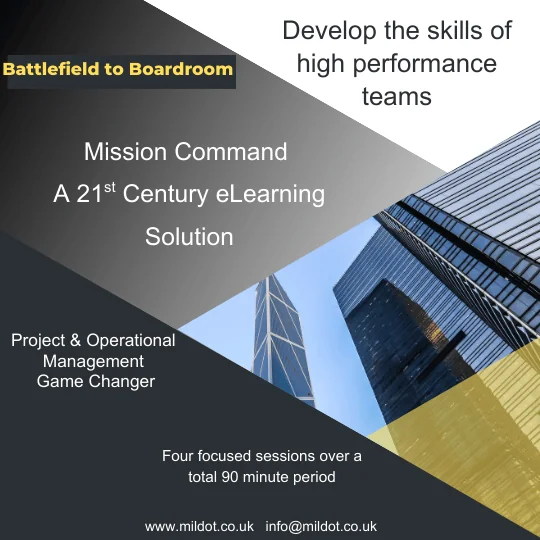
If your people freeze when plans change, your problem is not effort. It is management philosophy. That is why a proper mission command eLearning review matters. In protective security, counter terrorism and high-pressure operations, the quality of decision-making at the point of friction decides outcomes long before a post-incident report is written.
Mission command (Performance Management) is often discussed as if it belongs only to the military. That is a mistake. The principle is highly relevant to security managers, operations directors, event leads, critical infrastructure teams and anyone responsible for performance management on projects and operations.
The real question is not whether mission command sounds impressive. It is whether an eLearning course can turn the concept into usable behaviour.
What this mission command eLearning review is really assessing
A useful review should not stop at presentation quality or whether the platform feels modern. Those things matter, but they are not the main event. The value of mission command training sits elsewhere – in whether it improves judgement, delegated decision-making, intent-led planning and action under pressure.
For that reason, this review uses an operational lens. Does the learning explain mission command clearly? Does it connect principle to practice? Does it challenge the learner to think? And most importantly, does it help people perform when communications break down, timings slip and the situation changes faster than the plan?
If the answer to those questions is yes, the course has value. If not, it risks becoming another compliance exercise with military language attached.
Where mission command fits in modern project & operations
Most organisations still lean too heavily on control. They build plans around approvals, escalation points and rigid reporting lines. That can look tidy on paper, but modern threats and risks expose old management thinking. Fast-moving situations do not wait for senior sign-off.
Mission command for the private sector offers a different model. Managers set clear intent, define the outcome, allocate resources and boundaries, then trust people to act within that framework. It is not the absence of control. It is disciplined proven decentralisation management approach.
That distinction matters. In a crowded venue, a transport hub, a corporate estate or an international project environment, frontline teams often see critical changes first. If they understand intent and have the confidence to act, your organisation gains time. If they have only been trained to wait for instruction, you lose it.
An effective mission command eLearning review therefore has to consider audience fit. This type of course is strongest when taken by supervisors, team leaders, planners and practitioners who influence live decisions. It can still benefit wider staff groups, but the return is highest where delegated judgement already matters.
Strengths of mission command eLearning
The first strength is accessibility. A classroom session can be powerful, but it is expensive to scale and difficult to schedule across dispersed teams. eLearning allows organisations to introduce a common doctrine quickly and consistently. For businesses working across multiple sites or countries, that matters.
The second strength is reflection. Good mission command training gives learners time to absorb a concept that is simple to state but harder to apply. Intent, trust, initiative and risk ownership all sound straightforward until a learner tests them against a real operational problem. Digital learning can create space for that thinking if the content is well designed.
The third strength is standardisation without excessive rigidity. That sounds contradictory, but it is one of the model’s advantages. Everyone learns the same framework, yet the framework itself supports local adaptation. In practice, that means the organisation can align around a single approach while still enabling local decision-makers to respond to conditions on the ground.
For individual practitioners, there is another benefit. Mission command training develops professional judgement, not just task recall. That gives it more enduring value than narrow process training. It sharpens how people think, not only what they do.
The limitations – and where some courses fall short
Not every mission command course deserves the label. Some programmes rely too heavily on historical military reference, with too little attention to commercial and civilian operating environments. That can weaken relevance for managers working in retail, hospitality, events, transport or corporate settings.
There is also a risk of over-simplification. Mission command is not a slogan about empowerment. It depends on competence, clarity, trust and accountability. If an eLearning course presents it as a licence for unstructured autonomy, it has missed the point.
Another common weakness is the absence of scenario pressure. Learners may understand the principle intellectually, yet still fail to apply it under stress. A strong course uses realistic decision points, competing priorities and uncertainty. A weak one relies on passive slides and generic end-of-module questions.
This is where buyers need to be disciplined. A polished interface is not evidence of operational value. The better question is whether the learning changes behaviour in planning rooms, control rooms and on the ground.
What good mission command eLearning should include
A credible course should begin with intent. Not as a buzzword, but as the organising idea behind action. Learners need to understand how to define a desired outcome clearly enough that others can act without constant supervision.
It should also deal properly with trust. That means upward trust and downward trust. Senior managers must trust their teams to make decisions, but teams must also trust that leaders will support sensible action taken within intent. Without that mutual confidence, mission command collapses into hesitation.
Decision-making under friction should be another core element. Good content recognises that information will be incomplete, timings will be imperfect and communications may degrade. Learners should be asked to work through those realities rather than pretend they can be designed away.
The course should also address boundaries. Effective delegation is not vague. It requires clear limits, authorities and priorities. In security settings, this is essential. Teams need to know what they can decide, what must be escalated and what trade-offs are acceptable.
Finally, assessment matters. If the evaluation only checks memory, it will not tell you whether the learner can apply mission command. Better courses test reasoning, judgement and response to realistic operational choices. That is the difference between content completion and capability development.
Who gets the most value from this type of training
The strongest fit is for organisations where local decisions carry operational consequence. That includes protective security teams, event command structures, corporate resilience functions, infrastructure operators and project environments where disruption can escalate quickly.
It is particularly useful for businesses preparing for higher standards of counter terrorism readiness and incident response. Compliance may create the requirement to train. Capability is what reduces real-world risk. Mission command supports that shift because it helps teams act with purpose when conditions are imperfect.
For individual learners, the course is most valuable to people moving into leadership, coordination or planning roles. It helps them understand that control is not the same as effectiveness. In many cases, better outcomes come from clearer intent and stronger subordinate judgement, not more layers of permission.
That said, the training is not a cure-all. If an organisation lacks baseline competence, weakens accountability or tolerates poor communication, mission command will not compensate for those flaws. It works best as part of a broader capability model that includes planning, exercising, after-action learning and leadership development.
A practical verdict on mission command eLearning review criteria
So how should a buyer or practitioner judge a course? Start with relevance. If the learning does not connect mission command to modern operational settings, its impact will be limited. Continue with realism. If there are no credible scenarios, learners will retain less and apply less. Then test transfer. Can the learner use the principles in briefings, planning, incident response and team leadership after the module ends?
A high-quality course should leave the learner with sharper questions, not just cleaner definitions. What is the intent? What freedom of action exists? What constraints apply? What can be decided now? What must be escalated? Those are operational questions. Training that reinforces them has practical value.
This is also where provider credibility matters. Organisations such as Mildot Group understand that security training has to turn theory into action. The standard should be simple: does the course improve readiness, or does it merely look educational?
Is it worth it?
For the right audience, yes. Mission command eLearning can be a worthwhile investment when it strengthens decentralised decision-making, clarifies leadership intent and improves performance under pressure. Its value rises further when the organisation uses the learning as part of a wider effort to build resilience through capability, not just policy.
But the answer depends on what you need. If you want a basic awareness module, almost any course may appear adequate. If you need people to think, decide and act better in live operations, your standard should be much higher. In that case, content quality, scenario realism and assessment design matter far more than platform gloss.
The best test is straightforward. After completing the training, are your people more likely to act with clarity when the plan starts to break? If the answer is yes, the course is doing useful work. If not, keep looking. Pressure reveals truth, and good training should prepare people for exactly that moment.
.
Useful Links:
.