A security plan that looks impressive in a board pack can still fail in the first ten minutes of a real incident. That void between documentation and performance is exactly where a protective security advisory programme matters. Done properly, it does not just tell an organisation what its risks are. It improves how people, systems and leadership actually respond when pressure arrives.
For organisations facing terrorism risk, hostile reconnaissance, public-facing vulnerabilities or heightened duty of care obligations, advisory support should never be reduced to a one-off report. Threats shift, operations change, teams rotate and assumptions age badly. A protective security advisory programme creates continuity. It gives decision-makers a disciplined way to assess risk, prioritise investment and build capability over time rather than reacting after an event, audit failure or near miss.
What a protective security advisory programme should do
At its best, a protective security advisory programme gives an organisation access to specialist judgement that is both strategic and operational. That means more than policy review. It means translating threat information, regulatory duties, site realities and organisational constraints into actions that work in the real world.
In practice, that often starts with understanding the operating environment. A hospitality group in a city centre, a crowded event venue, a critical infrastructure site and a corporate headquarters may all face hostile intent, but the threat picture, attack pathways and acceptable controls are not the same. Good advisory work reflects that. It does not rely on generic templates or fashionable language.
The programme should then connect risk assessment with capability development. If a vulnerability is identified at perimeter access, visitor screening, incident escalation or crisis communications, the answer is not always a new piece of kit. Sometimes the issue sits with decision-making, training standards, contractor oversight or poor alignment between operational and security teams. Advisory support only has value when it can distinguish between those causes.
Why many security programmes underperform
A common weakness in security planning is the belief that compliance equals readiness. It does not. Compliance can help establish a baseline, but baseline controls are not the same as operational performance under pressure.
This is especially relevant for organisations preparing for stronger counter terrorism expectations, including those shaped by Martyn’s Law. The legal and moral pressure is rising, particularly for publicly accessible locations. Yet many organisations still approach preparedness as a documentation task. They produce policies, complete gap analyses and hold a briefing, then assume capability exists. That is optimistic at best.
A credible advisory programme tests whether security measures can survive contact with reality. Are frontline staff confident enough to challenge suspicious behaviour? Do duty managers understand escalation thresholds? Can senior leaders make time-critical decisions with limited information? Are technical systems configured to support the response plan, or simply installed to satisfy procurement? These are operational questions, not branding exercises.
The core elements of an effective protective security advisory programme
The exact design depends on the organisation, but the strongest programmes usually combine several strands of support into a single operating picture.
Threat, vulnerability and risk assessment
This is the foundation. Without it, organisations either overspend on low-value controls or leave critical gaps untouched. Assessment should be current, specific and tied to how the site or operation actually functions. It should account for hostile threats, predictable vulnerabilities, crowd dynamics, access arrangements, insider risk and the implications of business disruption.
Security strategy and proportionate planning
Once the picture is clear, leadership needs priorities. That means deciding what must be fixed now, what should be improved over time and what level of residual risk is acceptable. This is where advisory support earns its place. The right adviser helps leaders make hard choices, not avoid them.
Technical and procedural alignment
Technology often enters the conversation too early. Cameras, barriers, alarms and access control can all add value, but only when they support a coherent concept of operations. If systems are poorly configured, unsupported by training or disconnected from response procedures, they create a false sense of security. Advisory programmes should make sure procedures, people and technology reinforce one another.
Training and capability development
Capability is not built by issuing guidance once a year. Teams need relevant learning, exercised responses and clear performance standards. For some organisations, that means accredited eLearning to build broad awareness efficiently. For others, it means targeted development for security leads, operations managers and practitioners who need deeper counter terrorism competence. The best programmes use learning to improve judgement, not just completion rates.
Review, assurance and adaptation
Security is not static. New venues open, footfall changes, contractors rotate, business priorities shift and threat actors adapt. Advisory support should therefore include periodic review, post-exercise analysis, incident learning and targeted updates. A programme that never changes is usually a programme that has stopped being useful.
Who benefits most from this approach
The organisations that gain the most are usually those operating in exposed, fast-moving environments. Retail centres, event organisers, hospitality groups, transport-adjacent sites, energy operators, corporate estates and venues with large public access all face a similar problem. They need controls that are credible without crippling the operation.
That balance is not simple. A visible security posture can reassure staff and visitors, but excessive friction can damage customer experience and disrupt flow. Light-touch arrangements may protect revenue, but they can also leave predictable weaknesses. A proper advisory programme helps organisations make informed trade-offs rather than defaulting to either theatre or passivity.
This is also valuable for organisations with limited in-house depth. Many security managers are expected to cover compliance, procurement, incident management and assurance at once. They may be highly capable, but still need specialist support on counter terrorism planning, behavioural threat indicators, vulnerability reduction or independent testing of assumptions. External advisory input can sharpen internal performance without displacing internal ownership.
What good advisory support looks like in practice
Good advisers are not there to overwhelm teams with jargon. They are there to improve decisions. That usually means asking difficult questions early, spotting weak assumptions and giving leaders a clearer route from risk to action.
For example, if a venue is concerned about hostile vehicle threat, the answer may involve physical protection measures. But it may also require revised traffic management, delivery scheduling, steward positioning, emergency access planning and staff briefings that reflect the actual operating rhythm of the site. The point is integration. Controls fail when they are designed in isolation.
The same applies to suspicious behaviour reporting. Many organisations tell staff to stay vigilant. Far fewer define what that means, explain the indicators that matter or build the confidence needed to report concerns properly. Behavioural risk is often mishandled because teams are either under-trained or worried about getting it wrong. A strong advisory programme closes that gap with practical guidance and realistic learning.
Where Mildot Group’s approach stands apart is in treating resilience as a capability problem, not a paperwork exercise. That matters because modern threats expose old security thinking. Organisations do not need more generic advice. They need support that turns theory into action, strengthens performance under pressure and reduces real-world risks.
Choosing the right protective security advisory programme
Not every programme needs the same level of depth. A single site with known vulnerabilities may need focused assessment and a short implementation plan. A multi-site operator with public access, contractor complexity and board-level scrutiny may need ongoing advisory support, capability diagnostics and structured improvement over months rather than weeks.
When choosing a provider, credibility matters. Operational experience matters. The ability to explain risk clearly to senior leaders matters. So does the discipline to say when a control is disproportionate, poorly specified or unlikely to work as intended. The best advice is not the most dramatic. It is the most usable.
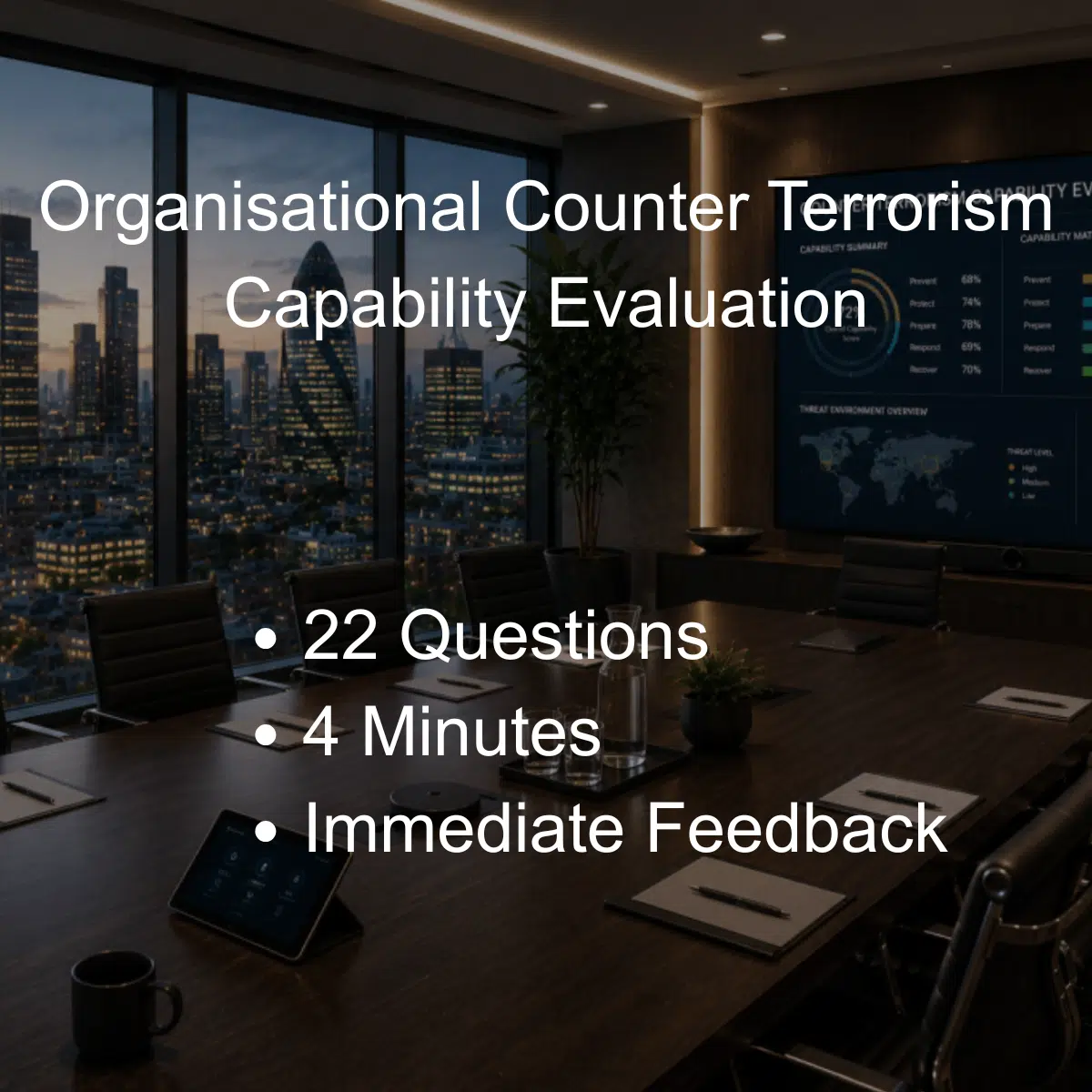
It is also worth looking at how the provider handles development beyond consultancy. Organisations rarely improve through reports alone. They improve when assessment, education, exercises and review are connected. That is often where digital evaluation tools, practitioner learning and targeted advisory input make a measurable difference. Immediate feedback, capability diagnostics and role-specific development can help move a team from awareness to competence far faster than static training alone.
The real test is performance under pressure
A protective security advisory programme should leave an organisation better able to prevent, prepare, respond and recover. If it only produces documents, it has missed the point. If it helps leaders understand risk, equips teams to act and improves decision-making when conditions are imperfect, it is doing its job.
Security leaders do not need theatre. They need clarity, credibility and practical support that stands up when a situation becomes time-critical. Start there, and improvement becomes measurable rather than rhetorical.
Useful Links:
.