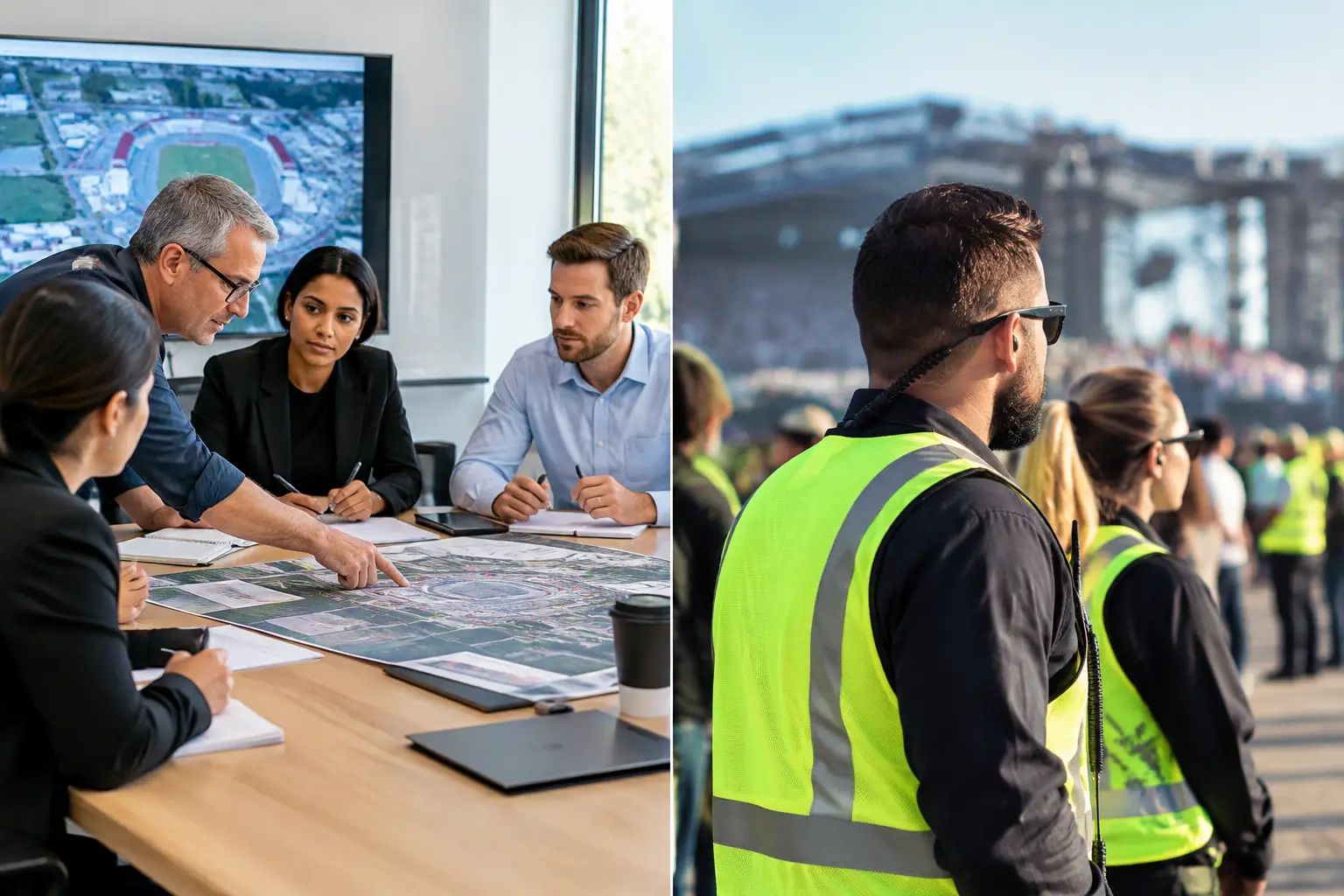
A retail counter terrorism training example should not be a test of whether staff can repeat a reporting acronym. It should show whether people can notice concern, make proportionate decisions, communicate clearly and protect customers without creating unnecessary disruption. That is the difference between awareness training and operational capability.
Retail is an exposed environment. Large numbers of people move through stores, shopping centres and retail parks with little friction. Staff are managing customers, stock, deliveries, complaints and commercial pressure at the same time. A security response that looks good in a classroom can fail quickly if it ignores those realities.
The most useful training puts people into a credible situation and asks them to make decisions with incomplete information. It also makes clear who is responsible for what. Staff do not need to become counter terrorism specialists. They do need to understand their role, their limits and the consequences of delay, assumption or poor communication.
A retail counter terrorism training example in practice
Consider a busy Saturday afternoon in a medium-sized department store. The duty manager is dealing with a staffing issue. A security officer is assisting with a welfare matter near the entrance. Floor colleagues are serving customers across several departments.
A member of staff notices an individual in a public area who appears unusually focused on entrances, staff routines and the location of security personnel. The individual is not committing an obvious offence. They leave after a short time. Later, another colleague reports an unattended bag close to a seating area, but cannot say how long it has been there or who placed it there.
The point of this scenario is not to invite guesswork about intent. Staff should not diagnose a terrorist threat from one behaviour, one item or one feeling. The point is to assess what has been observed, report it accurately and take sensible protective action through established management arrangements.
A capable team begins with facts. What was seen? Where and when? Who else may have seen it? Is there an immediate concern requiring action to protect people? What information must reach the duty manager, control room or security lead without being distorted by assumption?
That sounds straightforward. Under pressure, it often is not. The colleague reporting the concern may be embarrassed, uncertain or worried about overreacting. The supervisor receiving it may be occupied and tempted to deal with it later. A good exercise exposes these human factors because they are where small failures become operational gaps.
What the exercise should test
Training should test judgement, not memory alone. The initial response should examine whether the staff member can report observations promptly and clearly, and whether the recipient recognises the need to take ownership. Vague messages such as “there is something suspicious” create confusion. Clear information enables a proportionate decision.
The next test is escalation. In a retail setting, staff need a known route for raising concerns and a clear understanding of when to involve those with authority, including emergency services where appropriate. This should be practised as part of normal operational management, not treated as an exceptional process that exists only in a folder.
Communication matters just as much as escalation. A duty manager may need to coordinate with centre management, neighbouring retailers, building security or police. Meanwhile, colleagues on the shop floor need sufficient direction to carry out their tasks safely without being given rumour, unnecessary detail or instructions beyond their competence.
The exercise should also test customer management. Retail teams cannot always stop trading at the first sign of uncertainty, nor should they carry on as though nothing has happened if a credible concern is being assessed. The right balance depends on the facts, the venue, the advice received and the organisation’s plans. Training should make this uncomfortable point clear: there is no universal script that removes the need for judgement.
A final element is continuity. If an area must be restricted, if customers need to be moved, or if normal access arrangements change, who manages tills, deliveries, vulnerable customers, staff welfare and communications? Security plans often describe the major decision. They are weaker on the practical consequences that follow five minutes later.
The decisions that reveal capability
The value of the scenario lies in the discussion after it. Ask the team why they made each decision and what information they relied on. If they cannot explain that, they may have followed a process without understanding it.
For example, staff may identify the unattended item but fail to preserve a clear account of its location, timing and who reported it. A manager may escalate appropriately but neglect to assign someone to brief affected staff. Another team may communicate well internally but allow speculative language to reach customers. None of these are failures of goodwill. They are capability issues that can be identified and improved.
The exercise may also expose a more basic problem: people do not know who is in charge outside normal hours. Many retailers operate with changing shift patterns, temporary colleagues, agency security, shared premises and high turnover. A plan that relies on one experienced manager is not a plan. It is a single point of failure.
This is why short scenario-based sessions can be more revealing than a long presentation. A presentation can confirm attendance. It cannot show whether a new supervisor can receive a report, establish the facts, involve the right people and keep their team focused when the situation is unclear.
Avoid training that creates false confidence
Retail counter terrorism training can become too generic when it focuses only on signs to look for. Observation is necessary, but it is only the start. A colleague who spots a concern but does not know how to report it has not improved the organisation’s resilience. Equally, a manager who knows the reporting route but cannot make calm, proportionate decisions may create disruption without improving safety.
There is also a risk in overloading front-line staff with complex procedures. People working on tills, shop floors, goods-in areas and customer service desks need simple, relevant instruction. They should know what good reporting looks like, who to contact and what they may be asked to do. The more detailed command, liaison and decision-making responsibilities sit with suitably trained managers and security personnel.
That division matters. It respects the role of the front line while ensuring responsibility is not pushed down to people without the authority, information or experience to carry it.
Training must reflect the physical environment as well. A standalone shop, a large shopping centre and a retail unit within a transport hub face different communication routes, management structures and constraints. One scenario cannot cover every contingency. It can, however, reveal whether the organisation understands its dependencies and has practical arrangements for working with others.
Turning the example into a useful assessment
Run the scenario in real time, preferably with the people who would actually respond. Keep it controlled and proportionate. The purpose is learning, not theatre. Give participants only the information they would reasonably have at each stage, then introduce updates that require them to reassess.
Assess the quality of reporting, the speed and appropriateness of escalation, decision ownership, internal communication and the management of customers and business activity. Record gaps in plain language. “Improve communications” is too vague to be useful. “Duty managers require a standard handover process for incident authority and contact details” is an action that can be completed and checked.
Repeat the exercise after improvements have been made. Capability is not established by running one scenario. It is demonstrated when people can apply sound judgement consistently, including when key personnel are absent or the store is busy.
Mildot Group’s approach to capability evaluation is based on this principle: the useful question is not whether training was completed, but whether the organisation can act effectively when information is incomplete and the pressure is real. For retail leaders, that is the standard worth measuring against.
The next time your team reviews counter terrorism training, ask a harder question than “who has completed the module?” Ask whether a colleague on the floor, a supervisor and a duty manager could each explain their role in the first critical minutes. Their answers will tell you far more about readiness than a certificate ever will.