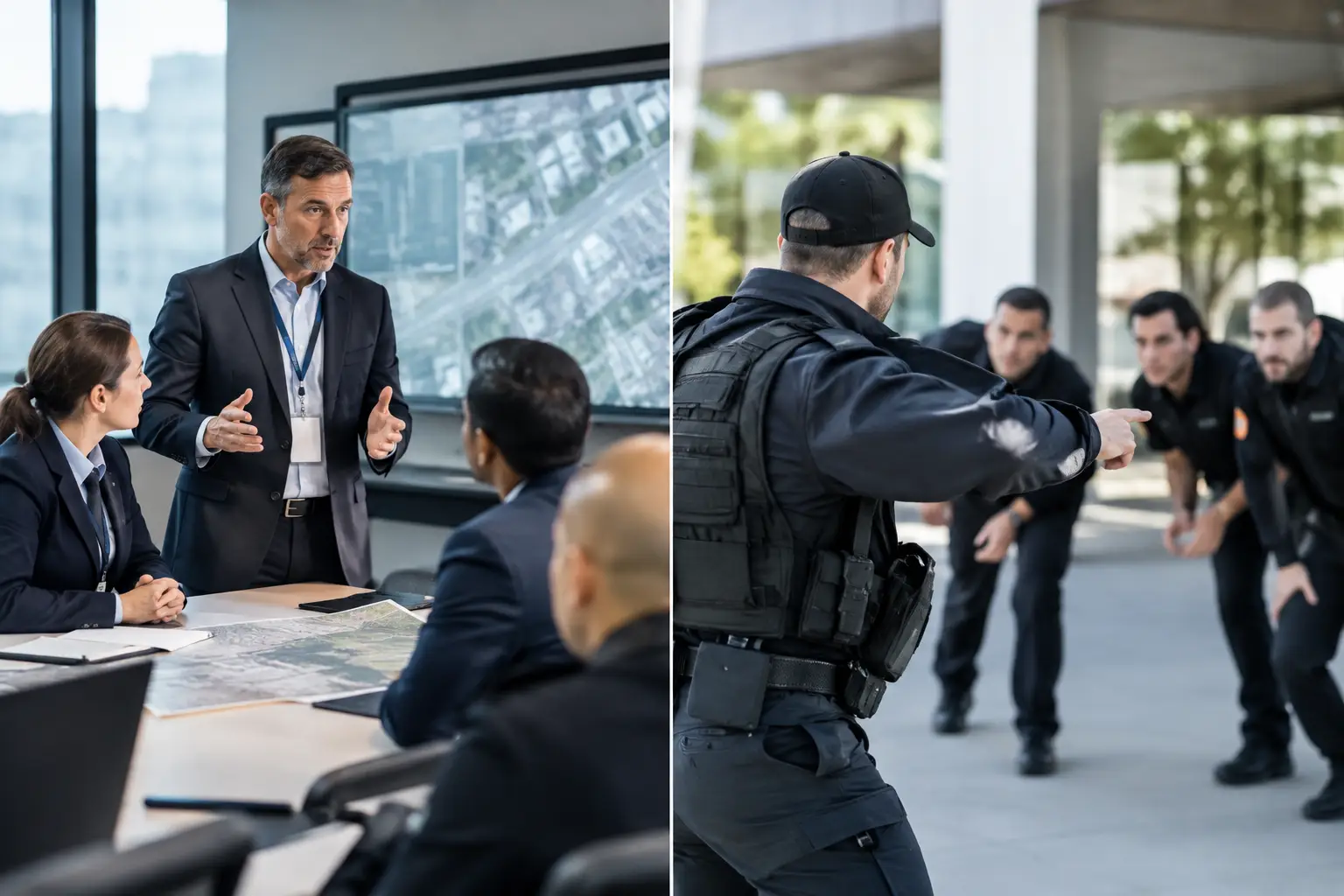
A suspicious report reaches the control room. The available detail is incomplete, the site is busy, and someone senior wants an answer immediately: close an area, increase patrols, notify police, or carry on. This is where a security decision making guide earns its value. It should not give people a script for every event. It should help them make a proportionate, defensible decision when certainty is unavailable.
Protective security decisions are rarely made with perfect information. Waiting for every fact can expose people and operations to avoidable risk. Acting on every concern as though it is an imminent threat can create disruption, alarm staff and undermine confidence in the security function. Good judgement sits between those two failures.
What Security Decision Making Actually Requires
The decision is not simply whether a reported concern is real. Security leaders must assess what is known, what remains uncertain, who or what may be exposed, and what action is justified at that point. They must also consider the consequences of getting it wrong in either direction.
This is why a risk matrix alone is insufficient. A matrix may provide a common language, but it cannot assess the credibility of a person reporting concern, identify a change in normal behaviour, or decide whether an operational response can be delivered safely. Those are judgement calls. They depend on context, trained observation, clear authority and people who understand the environment they are protecting.
A shopping centre, a construction project, a corporate office and a crowded event may face a similar report but require different decisions. The site layout, public access, evacuation arrangements, staffing, time of day, nearby activity and local emergency response arrangements all affect the position. A decision that is proportionate at one location may be inadequate or excessive at another.
The practical test is straightforward: can the person making the decision explain what they knew, what they did not know, why the chosen action was necessary, and how they intended to review it? If not, the organisation may be relying on instinct without a reliable decision process.
A Security Decision Making Guide Under Pressure
Under pressure, people tend to narrow their focus. They may fixate on the initial report, follow the loudest voice in the room, or select the least disruptive option because it feels commercially easier. A sound process creates enough structure to counter those habits without slowing action.
Establish the facts without forcing certainty
Start by separating direct observation from assumption. Who reported the concern? What did they actually see, hear or receive? Where and when did it occur? Is there any corroboration from CCTV, access control records, staff observations or a second source?
This does not mean conducting a lengthy investigation before acting. It means avoiding the common error of turning an uncertain report into an established fact through repetition. “An unidentified person was seen near a restricted entrance” is not the same as “there has been an attempted breach”. The wording shapes the response.
At the same time, look for changes from the normal operating picture. An unlocked door may be a facilities issue. An unlocked door alongside unusual access activity, an unaccounted visitor and a staff report of surveillance presents a different pattern. The value lies in connecting relevant indicators, not treating each one in isolation.
Define the decision that is needed now
Teams often waste time discussing a broad problem when an immediate, narrower decision is required. Ask: what must be decided in the next five minutes? It may be whether to restrict access to a particular area, move people away from an uncertain hazard, deploy a supervisor to verify information, or escalate for specialist advice.
Be precise about authority. If the duty manager can close a loading bay but cannot suspend an event, both limits must be understood before an incident occurs. Delayed decisions are often caused less by poor threat assessment than by uncertainty over who is permitted to decide.
The initial action should be reversible where possible. Increasing observation, controlling entry or moving staff to a safer position can buy time and improve the information picture. Reversible action is not weak action. It is often the most professional response when facts are incomplete.
Compare options against operational consequences
A useful decision considers more than the perceived threat. It asks what each option will achieve, what risk it introduces, and whether the organisation can carry it out properly.
For example, restricting access to a building entrance might reduce exposure to an uncertain concern. It might also create crowding at another entrance, block an accessible route or place staff in a confrontational position. Those effects do not necessarily mean the restriction is wrong. They mean the decision maker must plan for them.
This is particularly relevant to counter terrorism preparedness. A generic instruction to “be vigilant” offers little help when a team needs to balance public safety, business continuity and the welfare of staff. The better question is: what practical control can we apply now, with the people and equipment available, that reduces risk without creating a new unmanaged problem?
Record the rationale, then review it
A brief contemporaneous record protects organisational learning as much as accountability. It should capture the source of information, the known facts, the action authorised, the person responsible and the point at which the decision will be reviewed.
Do not confuse recording with decision making. A detailed log will not compensate for a poor call. However, without a record, teams cannot reliably examine whether their judgement was sound or whether assumptions became embedded as fact.
Set a review trigger. This could be the arrival of further information, completion of a check, a specified time, a change in crowd density or advice from emergency services. Decisions made during an unfolding situation should be treated as provisional unless the evidence clearly supports a final position.
The Behavioural Risks That Distort Judgement
Experience can improve judgement, but it can also create overconfidence. A manager who has dealt with dozens of harmless reports may unconsciously minimise the next one. Another manager may overreact because a past incident is still vivid in their mind. Neither response is necessarily malicious or careless. Both are predictable human tendencies.
Confirmation bias is particularly damaging. Once a team forms an early view, it may seek information that supports it and dismiss information that does not. A practical safeguard is to ask one person to articulate the alternative explanation. What would we expect to see if the concern were benign? What evidence would change our current decision?
Group dynamics matter as well. Junior staff may hesitate to challenge a senior colleague, even when their direct observation contradicts the accepted picture. Leaders set the standard by asking for dissenting information before committing the team. A calm challenge is not indecision. It is quality control.
Fatigue, workload and competing commercial demands also affect judgement. Organisations should not assume that capable individuals will consistently perform well if the decision environment is poor. Clear escalation routes, realistic staffing, rehearsed communications and access to competent advice reduce the burden on the individual at the critical moment.
Test Decisions Before an Incident Tests Them
Plans commonly describe roles, communications and evacuation arrangements. They less often test the decisions people must make before those arrangements are activated. That gap matters. People can know where the emergency plan is stored yet still be unable to decide when to use it.
Short scenario discussions are useful when they are specific. Present the team with partial information, a time constraint and a realistic operational complication. Ask what they would do first, who would authorise it, what evidence they need, and what would cause them to change course. The purpose is not to find a perfect answer. It is to expose unclear authority, weak situational awareness and assumptions that have not been challenged.
Assessment also has a role. Capability diagnostics can identify whether practitioners understand decision principles across threat recognition, escalation, operational planning and response. Results are most useful when they lead to targeted development rather than being treated as a pass or fail badge.
For organisations preparing for duties associated with Martyn’s Law, this distinction is central. A policy may define responsibilities, but it cannot make a person recognise an emerging concern, communicate a clear instruction or select proportionate action under pressure. Those abilities need practice, feedback and leadership attention.
Build Decision Confidence Through Capability
Decision confidence is not the confidence to act quickly regardless of the evidence. It is the confidence to make a reasoned call, explain it clearly and adapt when new information changes the picture.
That confidence comes from people who understand their site, know their authority, recognise behavioural and operational indicators, and have practised the conversations that precede difficult action. It comes from leaders who reward accurate reporting and constructive challenge rather than demanding false certainty.
The next time your team reviews a security plan, ask a harder question than whether every section is complete: when information is partial and the consequences matter, who will decide, what will guide them, and will the rest of the organisation support the action they take?