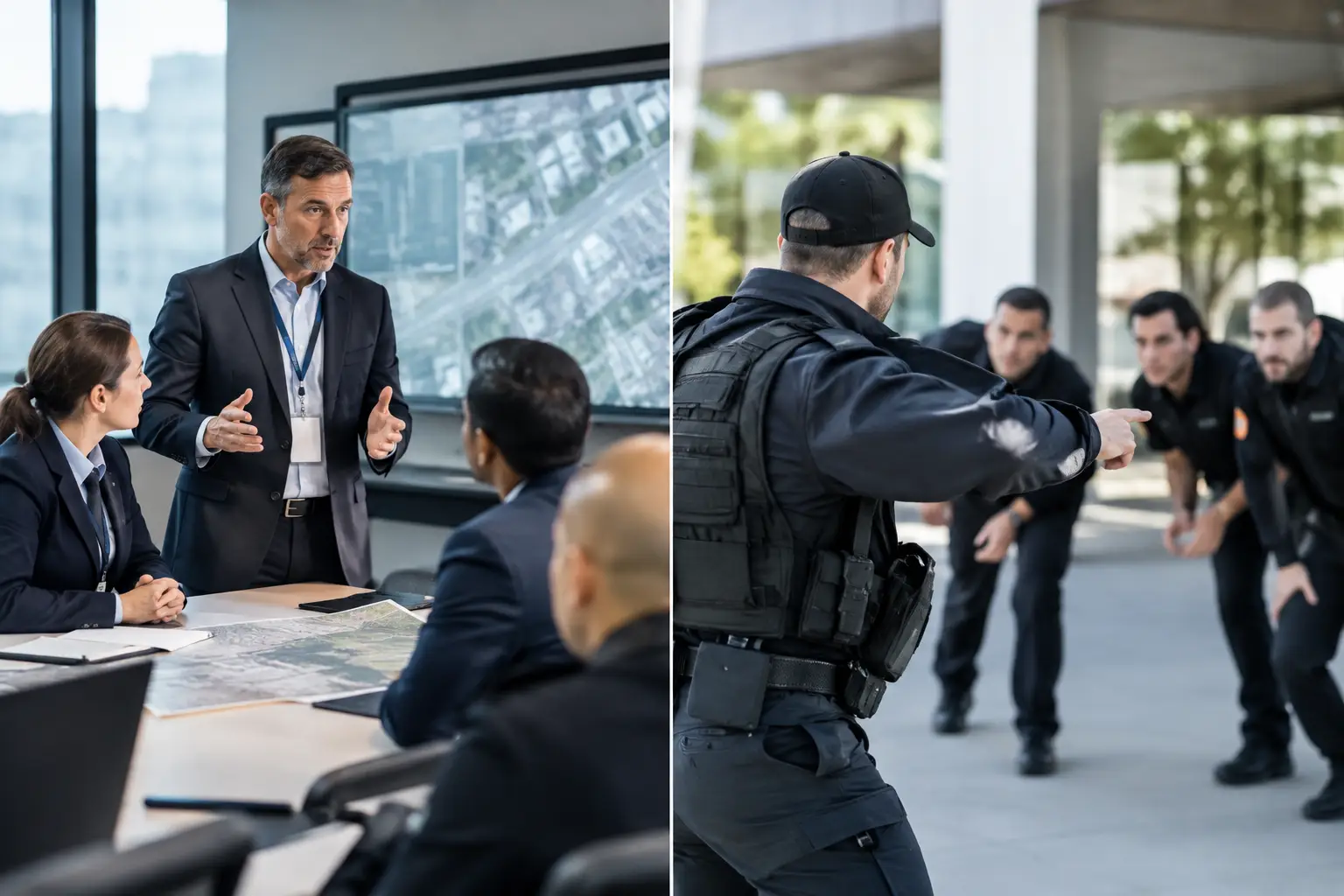
A certificate does not tell you whether someone will notice a developing problem, challenge an unsafe decision or take control when information is incomplete. Security training is often judged by attendance, completion rates and audit records because those things are easy to measure. Capability is harder to see until it is needed. That is precisely why it deserves more attention.
For organisations with responsibility for people, premises and operations, the question is not whether training has been delivered. It is whether people can apply it in the conditions they actually face: competing priorities, time pressure, uncertainty, poor communication and the natural reluctance to cause disruption.
Why much security training fails to change performance
Most people do not fail because they have never heard the policy. They fail because they cannot turn knowledge into a timely decision. They may recognise a concern in hindsight, yet hesitate at the point where they need to ask a question, escalate it or alter a plan.
This is where generic awareness content reaches its limit. It can introduce terminology, legal duties and broad principles. It rarely develops judgement. A learner can pass a multiple choice assessment by remembering the expected answer without being able to distinguish relevant information from background noise in a busy workplace.
The same problem appears in exercises that are too predictable. If every scenario contains obvious warning signs and a clear reporting route, participants learn to spot the training pattern rather than assess a real situation. Operational environments are less tidy. A concern may emerge through a change in behaviour, an unusual request, an inconsistency in access arrangements or a decision that does not fit normal activity. No single sign proves intent. Context matters.
There is also an uncomfortable organisational issue. Staff are frequently told to report concerns, then find that reports disappear into a process with no feedback, no clear ownership and no visible consequence. People soon learn that raising a concern creates work but achieves little. Training cannot compensate for a weak reporting culture.
Security training should build decision makers
Good training turns theory into action. It helps people understand what they are responsible for, what sits outside their authority and how to make a proportionate decision before the perfect information arrives.
That requires more than explaining threats. Learners need to practise recognising what is normal in their own environment, identifying meaningful deviation and choosing the next sensible action. For a venue manager, that may mean pausing an arrangement that has changed without proper confirmation. For a facilities team, it may mean checking an unexplained access issue rather than assuming someone else owns it. For a senior manager, it may mean supporting a cautious decision even when it causes inconvenience.
The quality of that judgement depends on role. A front line colleague does not need the same depth of knowledge as a security manager or counter terrorism practitioner. Giving everyone the same course may look fair, but it often produces shallow learning for specialists and irrelevant content for others. Training should have a common baseline, then build role-specific competence where the decisions carry greater consequence.
This is particularly relevant as organisations prepare for strengthened protective security expectations under Martyn’s Law. Documentation and training records will matter, but they are not the end state. An organisation needs people who can make sensible, lawful and timely decisions in its own setting. A plan that cannot be used by the person on duty is not a plan that improves resilience.
Start with the decisions that matter
The most useful starting point is not a course catalogue. It is an honest look at the decisions people are expected to make.
Ask where uncertainty, delay or poor judgement could create avoidable exposure. Consider who receives a concern first, who decides whether activity should change, who communicates with staff and visitors, and who records what happened for learning afterwards. Look at ordinary operations, not only the major incident scenario. Weaknesses often show themselves in routine handovers, contractor management, access control, event planning and changes to normal procedures.
A credible training need analysis should also test assumptions. Senior leaders may believe a site team understands escalation because a policy says so. The site team may know the policy exists but be unclear about thresholds, contact points or decision authority. Neither view is unusual. The gap becomes visible only when people are asked to work through realistic situations.
Capability evaluation has a role here. Well-designed assessments can identify where knowledge is sound, where confidence exceeds competence and where development needs to be more focused. Immediate feedback is valuable when it explains the reasoning, not merely whether an answer was right or wrong. The aim is not to catch people out. It is to give individuals and organisations a usable picture of current capability.
Make learning credible enough to be remembered
Training is more likely to transfer into practice when it resembles the working environment. That does not mean revealing sensitive details or creating dramatic simulations. It means using decisions, constraints and language that learners recognise.
A retail manager may need to balance customer service, staff welfare and security procedures during a busy period. An operations lead may need to make a call when a contractor’s arrangements do not match what was agreed. A project manager may need to challenge a late design change that affects protective measures. Each situation involves more than technical knowledge. It involves confidence, communication and accountability.
Learning should give people an opportunity to explain their thinking. The explanation often reveals more than the selected answer. Someone may reach a sensible outcome for poor reasons, or choose an imperfect option while identifying the right uncertainty and escalation route. That distinction matters when developing practitioners.
Short, targeted digital learning can be highly effective for awareness, refresher training and consistent delivery across dispersed teams. It is not a lesser option simply because it is online. Its value depends on design, relevance and whether the organisation uses the results. For complex roles, it should sit alongside discussion, scenario work, coaching and practical review. There is no single delivery method that suits every risk or every learner.
Test the organisation, not only the individual
Security performance is a system outcome. A well-trained individual can still be constrained by unclear authority, poor communications, inaccessible information or a culture that punishes sensible escalation.
After training, test a few practical questions. Can people find the current procedure when they need it? Do supervisors respond consistently when a concern is raised? Are handovers clear? Does the control room, reception point or duty manager know who holds decision authority out of hours? Can teams explain what they would do first, rather than recite what the policy says?
This does not require an elaborate exercise programme for every organisation. A structured discussion around a realistic scenario can expose significant gaps in an hour. The important point is that findings lead to action. If training identifies uncertainty over roles, clarify them. If managers lack confidence to make proportionate decisions, develop that judgement. If reporting routes are cumbersome, fix the route rather than telling staff to try harder.
Measure what changes after training
Completion data has value, but it is an administrative measure. It shows who has accessed content, not what has changed. Better indicators include the quality of reports, the speed and appropriateness of escalation, improvements in assessment results over time, observations during exercises and the reduction of repeat errors.
Numbers need interpretation. More reports may indicate a worsening environment, but they may also show that people are more alert and willing to speak up. Fewer reports are not automatically good news. Leaders should look at the substance of reports, the decisions made and the learning that follows.
Training also needs maintenance. Knowledge fades, personnel change and operations evolve. Refresher activity should not be a yearly replay of the same slides. Use it to address real lessons, changes in risk, recurring misunderstandings and the decisions people are currently struggling to make.
The test of security training is not whether people can describe the threat in a classroom. It is whether they can recognise uncertainty, communicate clearly and take the next proportionate action when normal work becomes less certain. That is the capability worth building, checking and improving.