Travel Safety & Security Training for Business and Personal Travel
.
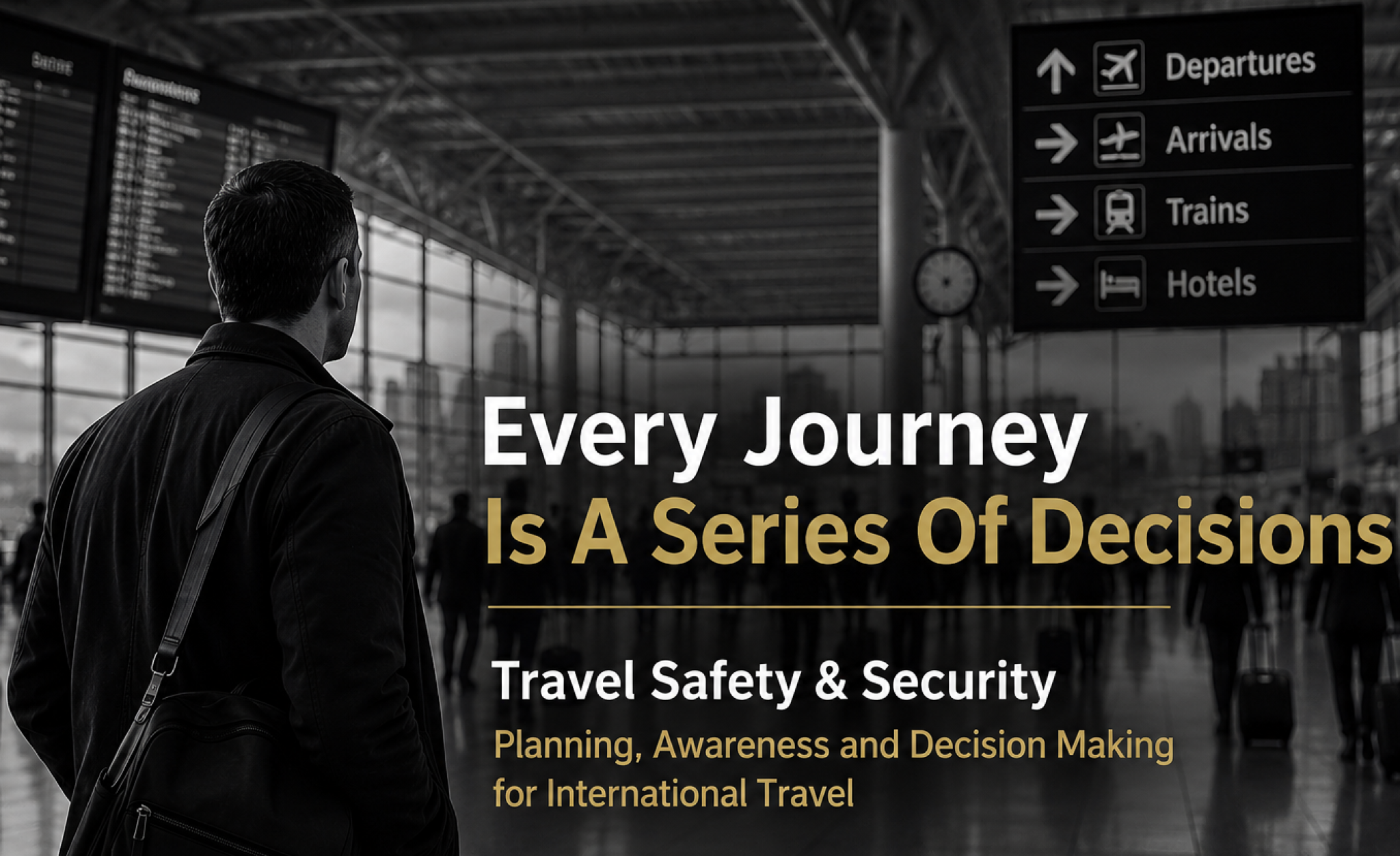
The flight lands after eight hours.
The traveller is tired, checking messages and thinking about what happens next. They collect their luggage, walk into arrivals and see someone waiting with their name displayed.
Everything looks normal.
And that is often where travel security begins to matter.
The journey might be for business, a family holiday or independent travel. The reason for travelling changes, but many of the decisions do not.
Most international travel passes without serious incident. The challenge is being prepared for the occasions when something does change, often when you are tired, distracted, under time pressure or somewhere you do not know.
The question is simple:
Would you recognise when something is not right and know what to do next?
.
The Journey Starts Before You Leave
Flights are booked. Accommodation is arranged. Transport may already be organised. Business travellers have meetings and work commitments. Personal travellers may have hotels, activities and onward journeys planned.
Everything appears ready.
But the traveller is about to leave an environment they understand and enter one they may not.
Different laws, customs, transport, communications and security conditions can all affect a journey. The traveller may be alone, with colleagues, with friends or responsible for their family.
Preparation is not about predicting everything that could go wrong.
It is about being ready when reality no longer matches the plan.
.
When Something Ordinary Deserves a Second Look
Back at the airport, the traveller approaches the waiting driver.
The name is correct. The location is correct. The timing is correct.
But is that enough?
Travellers make decisions like this constantly. Almost all will be routine. Occasionally, something will not be quite as expected.
That does not mean treating every unfamiliar person or situation as suspicious. It means having the awareness to recognise when something deserves more attention before making the next decision.
A few seconds of judgement at the right moment can prevent a much more difficult problem later.
.
Familiarity Changes How We Behave
Several days later, things feel different.
The traveller knows the route between the accommodation and the places they regularly visit. They recognise some of the staff, know where to eat and feel more comfortable moving around.
But has the environment become safer?
Or has the traveller simply become more comfortable in it?
People naturally adapt. What received attention on the first day can become routine by the fourth. Decisions that were initially considered carefully can gradually become automatic.
This applies whether someone is travelling for business, exploring a city alone or taking their family on holiday.
Familiarity can change our behaviour long before it changes the risk.
.
Ordinary Conversations Can Reveal More Than Expected
During the journey, the traveller meets drivers, hotel staff, business contacts, other travellers and people socially.
Conversations begin naturally.
Where are you from? How long are you staying? What brings you here? Where are you staying?
Usually, they are exactly what they appear to be: ordinary conversation.
But travellers can reveal far more than they realise.
A business traveller may discuss their organisation, colleagues, movements, projects or clients. Someone travelling personally may reveal where they are staying, who they are with, where they are going next or how long they will be away.
The answer is not to become suspicious of everyone who starts a conversation.
It is to recognise that travel security is about more than physical safety. Your information, belongings, movements and the people travelling with you can all matter.
.
Then the Plan Changes
Later in the journey, something changes.
Expected transport is no longer available. A route is disrupted. Communications become difficult. Local circumstances change or an arrangement that worked yesterday is no longer possible.
Now the traveller has to make a decision.
This is where planning meets reality.
The original plan may still be useful, but blindly following it simply because it was the plan may no longer make sense.
There may also be nobody immediately available to provide an answer.
That is when the value of preparation becomes visible. Not because the traveller can remember a long list of instructions, but because they have enough understanding and confidence to stop, reassess what is happening and make a credible decision.
.
The Journey Ends. The Capability Does Not.
Eventually, the traveller returns home.
No major incident occurred. There was no emergency and nothing dramatic to report.
That does not mean travel security was unnecessary.
Good travel security can be almost invisible. A problem may never develop because an assumption was questioned, unnecessary information was not disclosed, a changing situation was recognised or a different decision was made before circumstances became more difficult.
More importantly, the knowledge and skills developed for international travel do not become redundant when the journey ends. Awareness, judgement and better decision making remain useful wherever you are.
For an individual, that means greater confidence in making decisions for themselves and the people travelling with them.
For an organisation, there is another consideration. Flights, hotels, insurance, emergency contacts and travel policies all matter, but none can make a decision for an employee standing in an unfamiliar environment when circumstances change.
There is a difference between arranging somebody’s travel and preparing somebody to travel.
.
What Should Travel Safety & Security Training Achieve?
Travel safety and security training should not frighten people with everything that could possibly go wrong. Nor should its value be measured by how many facts somebody can remember immediately after completing a course.
It should produce a more capable traveller.
Someone better prepared before they leave, more aware while they are away and better able to make sound decisions when circumstances change.
The purpose is not to turn people into security professionals.
It is to give ordinary travellers practical knowledge and skills they can actually use.
That requires training grounded in the reality of travel rather than generic advice that is learned for a journey and quickly forgotten afterwards.
Because whether someone is travelling for work, independently or with their family, the real value of training appears when there is nobody standing beside them telling them what to do.
.
Develop Your Travel Safety & Security Capability
The Mildot Group Travel Safety & Security Programme is a three hour accredited CPD programme designed to develop practical capability for international travel.
This is not training built around simply remembering generic travel safety advice. It is reality driven, developed around the situations, decisions and changing circumstances people encounter when travelling.
Designed for business and personal travellers, the programme develops practical knowledge, awareness and decision making skills that remain relevant long after the journey is over.
These are not skills for one trip. They are skills you can use for life, wherever you travel.
Individuals can complete the programme independently, while Corporate & Group Accounts allow organisations to develop the same capability across employees who travel internationally.
Prepare properly. Travel with greater awareness. Develop skills you will use for life.
.
Useful Links:
.