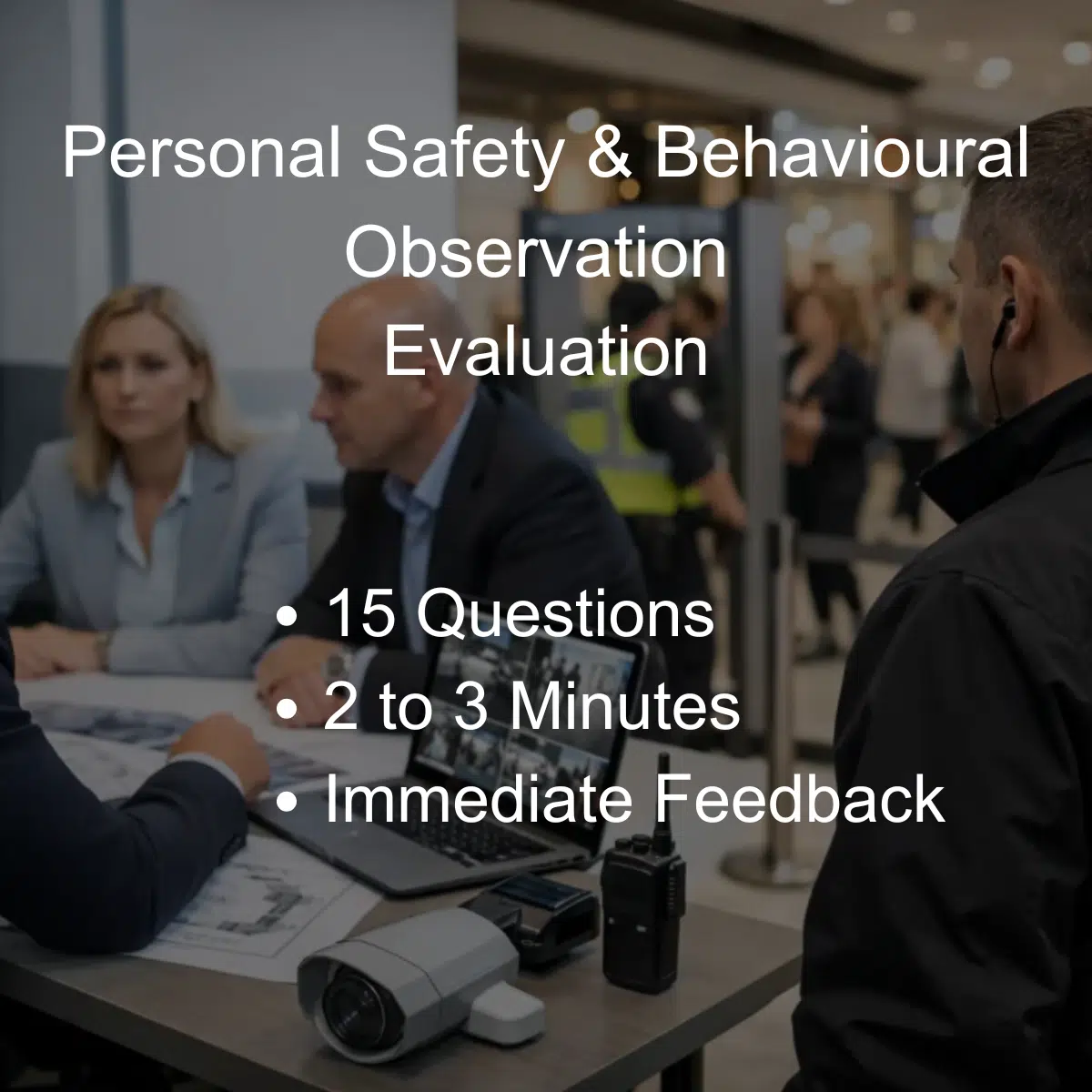
A team member notices a customer whose behaviour is off-pattern near a crowded entrance, but hesitates. Another sees the same person and says nothing because they are not sure what matters, what to report, or whether they are overreacting. That pause is where exposure grows. Personal safety & behavioural observation skills capability evaluation with immediate feedback addresses that exact problem by testing how people observe, interpret and act before a weak response becomes an operational failure.
For organisations carrying elevated threat exposure, this is not a soft skill. It is a core capability. Frontline staff, supervisors, security teams and operational leaders all make judgements under pressure. The question is whether those judgements are based on real competence or assumed confidence.
Why personal safety & behavioural observation skills capability evaluation matters
Modern threat environments punish delay, ambiguity and poor judgement. Retail, hospitality, events, transport, critical infrastructure and high-footfall corporate settings all depend on people noticing what is unusual early enough to make a difference. Technology supports that effort, but people still interpret context, assess behaviour and decide whether to escalate.
That is why capability evaluation matters more than attendance on a course. Training can inform. Evaluation shows whether the learning holds when the individual must apply it. Immediate feedback then closes the gap between theory and action while the scenario is still fresh.
There is a practical advantage here. Most organisations already know they need stronger awareness, better reporting and clearer decision-making. What they often lack is a credible way to measure current performance. Without that diagnostic view, investment becomes guesswork. Teams may feel reassured because training has been completed, yet remain weak in observation, situational judgement or personal safety decision-making.
The problem with awareness training on its own
Many awareness programmes stop at exposure to information. Staff are told what suspicious behaviour might look like, reminded to stay alert, and given a reporting route. That has value, but it does not prove capability.
Capability sits at the point where perception, interpretation and response meet. Can an employee distinguish between normal stress, poor customer behaviour and indicators that justify concern? Can a supervisor balance customer service pressures with protective security judgement? Can a practitioner recognise hostile reconnaissance indicators without defaulting to either complacency or overreaction?
It depends on the environment. A hotel lobby, a stadium perimeter and a corporate reception each produce different behavioural baselines. The same observed action may mean very different things depending on location, crowd density, timing and intent indicators. That is why generic training often underdelivers. It treats behavioural observation as a checklist when, in reality, it is a decision skill.
A proper personal safety & behavioural observation skills capability evaluation with immediate feedback tests that decision skill directly. It does not ask whether someone has seen the slides. It asks whether they can think clearly, recognise meaningful cues and make a defensible judgement.
What a good evaluation should actually test
A credible evaluation must go beyond memory recall. If the assessment only checks definitions, it tells you little about operational readiness. Stronger evaluation focuses on how individuals process information and act under realistic constraints.
That means assessing situational awareness, behavioural interpretation, threshold judgement, reporting quality and personal safety choices. It should test whether a person can spot anomalies without seeing threat everywhere. It should also test restraint. False positives create friction, waste time and undermine trust in reporting systems.
The best evaluation models also expose the why behind mistakes. Someone may miss an indicator because their baseline assumptions are poor. Another may spot the behaviour but fail to escalate because they do not trust internal reporting routes. A third may understand the issue intellectually but struggle when time pressure or competing tasks are introduced. These are different problems, so they require different interventions.
Immediate feedback matters because delay weakens learning. When people receive a clear explanation of what they noticed, what they missed and why their judgement was strong or weak, improvement becomes more likely. The feedback should be direct, educational and operationally relevant. It should not feel academic. It should help the learner perform better on shift, in public-facing environments and during incidents.
Immediate feedback changes behaviour faster
There is a reason immediate feedback has greater value than a report sent weeks later. Security performance is shaped by habits. If poor judgement goes uncorrected, it hardens into routine. If strong judgement is explained and reinforced quickly, it becomes repeatable.
For organisations, this creates a measurable improvement cycle. Individuals can see where they stand. Team leaders can identify patterns across departments, locations or functions. Decision-makers gain evidence for where to focus time, coaching and investment.
This is especially useful where organisations are working to strengthen preparedness under Martyn’s Law expectations or broader protective security obligations. Documentation has a place, but performance is what counts when pressure rises. Immediate feedback supports that performance by turning assessment into learning at the point of need.
There is also a cultural effect. Teams respond better when capability evaluation is positioned as professional development rather than fault-finding. High-performing organisations are not built by pretending everyone is ready. They are built by identifying gaps early and improving them without ambiguity.
From individual scoring to organisational capability
One of the most common mistakes in security development is treating individual performance in isolation. Behavioural observation and personal safety are not only personal competencies. They are part of a wider operating system.
If multiple staff members fail to report a concern, the issue may not be awareness alone. The threshold for escalation may be unclear. Managers may be inconsistent. Reporting channels may be too slow, too informal or poorly understood. Evaluation data becomes useful when it reveals these wider patterns.
That is where a structured diagnostic approach has value. It can show whether capability gaps sit with frontline perception, supervisory judgement, policy clarity or leadership expectations. This matters because the wrong fix wastes resources. More training will not solve a broken escalation culture. Equally, a new procedure will not help if people cannot interpret behaviour accurately in the first place.
Mildot Group’s approach reflects this operational reality. Capability evaluation works best when it informs wider improvement, not when it sits as a stand-alone score with no action behind it.
Where behavioural observation is often misunderstood
Behavioural observation is sometimes framed too narrowly, as though it means spotting a single suspicious individual. In practice, it is broader. It includes recognising pre-incident indicators, changes in crowd mood, fixation behaviour, concealment cues, inappropriate interest, stress responses and environmental anomalies.
It also requires discipline. Observation must not drift into assumption, bias or superficial profiling. Effective capability development teaches people to focus on behaviour, context and indicators rather than appearance or instinct alone. That is essential both operationally and professionally.
This is another reason evaluation matters. It shows whether people are applying sound behavioural principles or relying on guesswork. Immediate feedback helps correct poor pattern recognition before it affects live decision-making.
What good looks like in practice
A useful evaluation framework gives organisations three things. First, it establishes a baseline. You need to know current capability before you can improve it. Second, it creates targeted development. Different roles need different depth. Frontline staff require practical recognition and escalation skills. Supervisors need stronger interpretation and control measures. Specialist practitioners may need deeper behavioural risk and counter terrorism judgement. Third, it provides repeatability. Capability should be measured over time, not assumed after a single intervention.
The strongest programmes are realistic, role-relevant and easy to deploy at scale. They should support individual learners while also producing management insight. If the results are too vague to guide action, the evaluation has failed. If the scenarios are too abstract to reflect real operating pressure, the outcomes will not transfer into the workplace.
There is no value in producing reassuring numbers that do not correlate with frontline performance. Better to expose an uncomfortable gap and fix it than to maintain false confidence.
A capability issue, not a communications issue
Many organisations describe security failures as communication problems. Sometimes that is true, but often the deeper issue is capability. People did not communicate because they did not recognise significance, lacked confidence in their judgement, or were unsure what action was proportionate.
That is why personal safety and behavioural observation need to be evaluated together. Observation without safe decision-making creates hesitation. Personal safety awareness without behavioural understanding creates noise. The two reinforce each other.
For leaders, the practical question is straightforward. Do your people know what to look for, understand what it may mean, and act in a way that reduces real-world risk? If you cannot answer that with evidence, not assumption, there is work to do.
The right evaluation process gives you that evidence quickly and turns it into improvement just as quickly. That is the real value of immediate feedback. It does not simply tell people how they performed. It sharpens judgement where it matters most – before the next live decision has to be made.
Useful Links:
.