
Situational Awareness & Behavioural Observation
.
Notice More. Recognise Problems Earlier. Make Better Decisions.
Most personal safety and security problems start with something you did not see.
A person.
A behaviour.
A change in the environment.
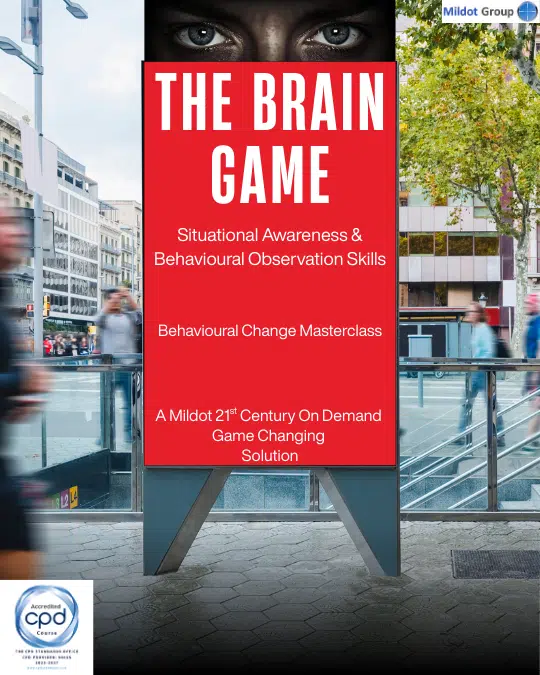
The Brain Game develops your ability to notice what others miss, read people and environments, recognise when something does not fit and make earlier, more informed decisions.
But knowing what to look for is only part of the answer.
The programme uses cognitive principles, practical exercises and habit development to progressively turn awareness and observation into skills that become more natural, automatic and effortless.
9 hours develops the capability. An 8 week guided development programme helps turn those skills into habits for everyday life.
9 CPD Credits | On Demand | 12 Months Access | £50
Built on Experience. Made Accessible.
First developed for classroom delivery in 2018 and made available on demand in 2023, the Brain Game has continued to evolve through practical delivery, lessons learned and learner feedback.
Today, it makes advanced situational awareness and behavioural observation development accessible to anyone, anywhere.
You learn how to:
• Read people and environments more effectively
• Recognise behavioural change and anomalies earlier
• Reduce the influence of distraction and cognitive bias
• Think ahead and anticipate developing situations
• Make faster, more informed decisions
• Develop passive and active awareness skills that become habitual
See more. Understand more. Decide earlier.
.

Skills for Life – Accredited – 9 CPD Credits
Few programmes go this far in turning situational awareness and behavioural observation into practical skills and lasting habits.
.
Also available as individual modules

Module 1 & 2: Developing Mental Alertness, Observation & Cognitive Awareness
Understand why people miss what is happening around them, and how distraction, cognitive overload, poor habits and bias can reduce everyday awareness.
Explore how alertness and observation work together, how changing levels of alertness affect your ability to respond, and how cognitive principles can be applied to develop stronger, more instinctive habits.
You will also understand how thinking and perception can be influenced without conscious awareness, helping you recognise and reduce your vulnerability to manipulation.
.

Module 3: Human Behaviour, Third Party Awareness & Information Protection
Understand how human behaviour, experience and instinctive responses influence the way people act, react and communicate, and how changes in behaviour can provide valuable information.
Develop greater awareness of who may be observing or listening to you, recognise patterns that may indicate unwanted attention and understand how everyday interactions can expose information.
You will also learn how people can exploit normal human behaviour to obtain information without making their intentions obvious, helping you recognise potential manipulation and better protect yourself and sensitive information.
.
.

Module 4 & 5: Building Habits, Behavioural Baselining & Anomaly Detection
Understand how awareness and observation skills can become more natural and automatic through consistent practice and habit development.
Develop the ability to rapidly assess environments and human behaviour, recognise when something requires greater attention and make more informed observations about what you are seeing.
You then put these developing skills into practice through realistic observation exercises, strengthening your ability to recognise potentially significant behaviour and act on what you observe with greater speed and confidence.
.

Module 6: Turning Skills into Faster Decisions & Automatic Responses
Bring together the awareness and observation skills developed so far and learn how to use them to recognise situations, make faster decisions and take appropriate action.
Develop the habits and repetition that help these skills become more automatic, reducing the time and conscious effort needed to recognise and respond to anomalies.
You then bring everything together through practical scenarios and cognitive exercises, strengthening your ability to recognise, decide and respond with greater speed and confidence as these skills progressively become habits.
.

Module 7: Rapid Environment Assessment
This module moves your developing skills forward, building your ability to rapidly read unfamiliar environments, reduce uncertainty and recognise what may require greater attention.
Learn how to think ahead, anticipate potential problems and make earlier decisions as you move through different environments.
We then walk you through realistic scenarios, bringing together the skills developed so far and showing how they work as a complete process, helping you understand how and when to apply them in different situations.
.

Module 8 & 9: Advanced Behavioural Observation, Skill Development & Cognitive Recall
These modules significantly advance your capability, moving beyond rapid assessment into a deeper understanding of environments, human behaviour and the significance of what you observe.
Develop your ability to recognise behavioural patterns, identify activity that may require closer attention and make more informed judgements about what you are seeing and why it matters. You will also develop stronger memory and cognitive recall to support awareness, observation and decision making.
We then bring together the skills developed throughout the programme through realistic scenarios, showing how awareness, observation and decision making work together when assessing people, behaviour and developing situations.
Finally, an eight week development programme provides a structured pathway for continued practice, helping turn what you have learned into stronger, more automatic habits that continue developing beyond the course.
.
Who Is the Brain Game For?
The Brain Game is for anyone who wants to become more aware of what is happening around them, better understand people and behaviour, and make more informed decisions.
It is particularly relevant for:
• Security professionals and frontline teams
• Lone and mobile workers
• Corporate and operational staff
• Frequent and international travellers
• Students and young adults
• Anyone wanting to improve their personal awareness and safety
No previous security experience is required.
What Will You Be Capable of Doing?
By the end of the programme, you will have developed practical situational awareness and behavioural observation skills that can be used in everyday life and at work.
You will be better able to read people and environments, recognise when something does not fit, identify behaviour that requires greater attention, think ahead and make earlier, more informed decisions.
The objective is not simply to make you more observant. It is to develop practical skills that become increasingly natural, automatic and effortless.
How the Programme Works
The Brain Game is completed online, at your own pace.
The core programme takes approximately 9 hours and combines learning with practical exercises, realistic scenarios and knowledge checks.
You receive 12 months access, giving you time to revisit the programme and continue developing your skills.
After the core programme, you can follow the 8 week development plan. Each week provides practical activities designed to reinforce what you have learned and progressively turn the skills into everyday habits.
Accredited Professional Development
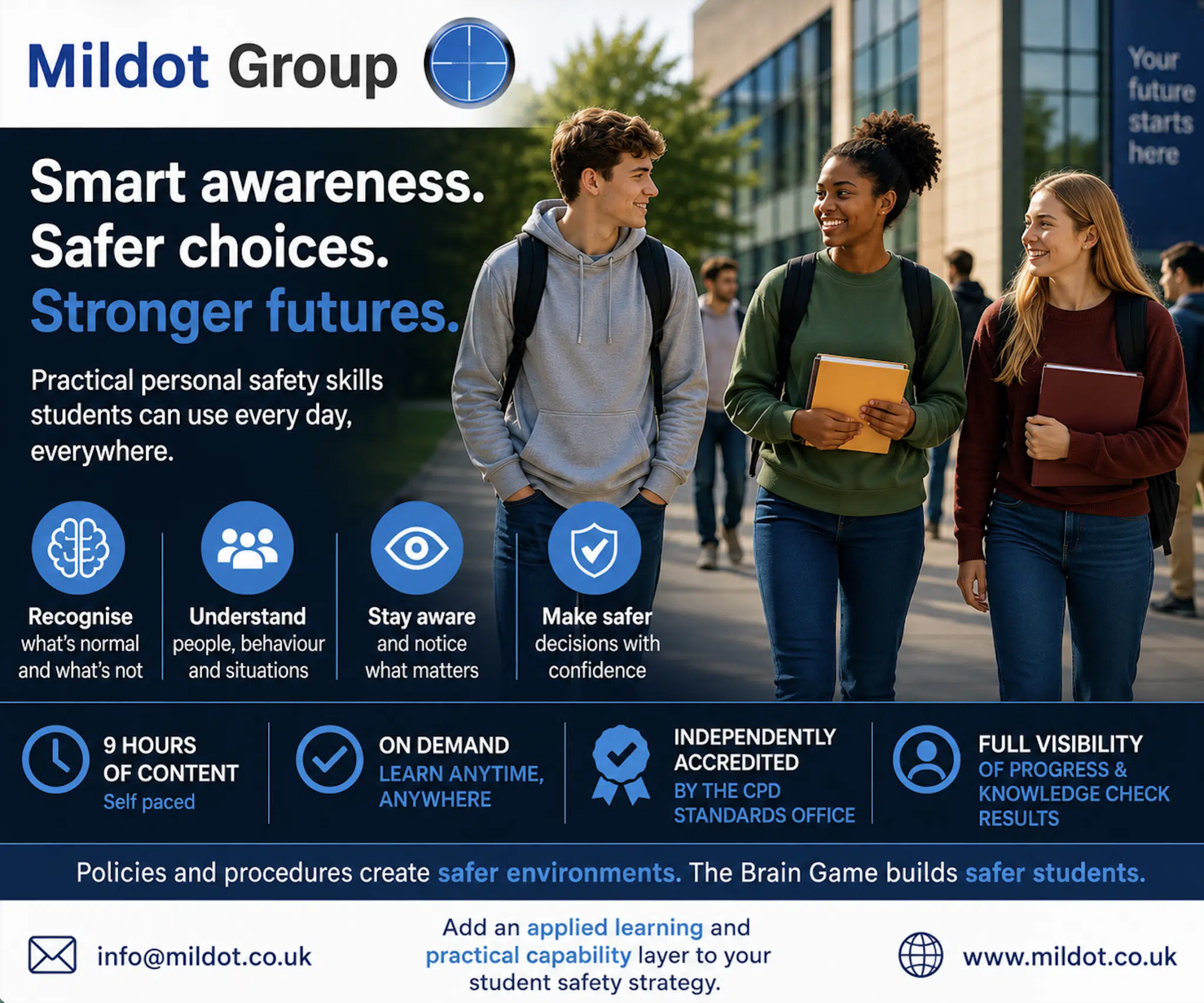
The Brain Game is accredited by the CPD Standards Office and provides 9 CPD credits.
Your certificate provides evidence of your professional development. The real value is the capability you take away and continue to develop.
The Brain Game can be delivered across teams and organisations through Corporate and Group Accounts.
You control learner access and can monitor progress and knowledge check results.
You can also combine the Brain Game with other Mildot Group programmes to create a package that meets your organisation’s requirements.
A practical and cost effective way to develop awareness, observation and decision making capability across your organisation.
Developed from Real World Experience
The Brain Game has evolved through years of practical delivery, learner feedback and continued development.
It brings together cognitive principles, behavioural observation and practical experience to help people notice more, better understand what they are seeing and make earlier, more informed decisions.
Develop Skills You Can Use Every Day
Situational awareness is not about constantly looking for danger.
It is about understanding what is happening around you, recognising when something changes and knowing when to pay greater attention.
The Brain Game gives you the knowledge, practical skills and development plan to build that capability and continue improving it.
9 hours core learning. 8 weeks guided development. 9 CPD credits. 12 months access.
Full Programme: £50
Or, Individual Modules from £10
Start developing your situational awareness and behavioural observation capability today.
.
Programme Format
Learn at your own pace through video, audio, written content, realistic scenarios and practical exercises.
Knowledge checks throughout the programme help reinforce your learning and track progress.
Complete the full programme to receive your 9 CPD credit certificate. Certificates of attendance are also available when completing individual modules.
..
Course Author & Instructor

.
Anthony Gledhill
Anthony Gledhill is the founder of Mildot Group and has more than 40 years of operational, corporate and private sector security experience.
His background includes 22 years in the British Army, followed by 19 years of international security roles and corporate security leadership across complex operating environments.
Throughout his career, situational awareness, understanding human behaviour and recognising changes in people and environments have been fundamental to making informed decisions and managing risk.
The Brain Game brings that experience together with established cognitive and behavioural principles to develop practical skills people can use in everyday life and professional environments.
Useful Links:
.