A venue manager gets the alert. A suspicious package has been reported near a busy entrance. The CCTV team sees movement, but the information is partial, the pressure is immediate, and the decision cannot wait for a policy document. That is where private sector counter terrorism 21st century eLearning solutions either prove their value or expose their weakness.
For organisations with real exposure – retail, events, hospitality, critical infrastructure, corporate estates and high-footfall environments – the standard for training has changed. Awareness alone is not enough. Staff need to recognise indicators, understand escalation thresholds, communicate clearly under pressure, and make sound decisions when facts are incomplete. If training does not improve operational behaviour, it has limited value.
What private sector counter terrorism 21st century eLearning solutions must deliver
The phrase is broad, but the requirement is specific. Effective private sector counter terrorism 21st century eLearning solutions should build practical capability, not just issue certificates. That means moving beyond passive content and towards learning that develops judgement, confidence and consistency.
A modern programme should reflect the way private sector risk now operates. Threats are faster moving, more decentralised and often harder to detect early. Frontline staff, supervisors and security leads may all see different parts of the same problem. Training has to help them interpret weak signals, not simply memorise definitions.
This is particularly relevant for organisations preparing for stronger protective security expectations, including those affected by Martyn’s Law were compliance matters, but capability matters more. A team that can apply sound practice in a live environment is in a stronger position than one that has completed a generic module with no operational relevance.
Why old training models fall short
Traditional security learning often fails in three predictable ways. First, it is too abstract. Learners are given concepts without the context needed to apply them in their own site, team or operating model. Secondly, it treats everyone the same. A control room supervisor, an events lead and a customer-facing employee do not need identical depth or decision authority. Thirdly, it measures completion rather than competence.
This is where many organisations lose momentum. They can show attendance, but they cannot show improved readiness. They have a training record, yet still lack confidence in how their people would respond to hostile reconnaissance, unattended items, dynamic evacuation pressures or post-incident coordination.
There is also a practical constraint. Private sector teams are busy. Shift patterns, contractor turnover, seasonal demand and dispersed sites make classroom-only delivery hard to sustain. eLearning solves part of that problem, but only if it is designed properly. Poor digital learning simply scales poor training.
The difference between information and capability
Useful counter terrorism training does more than tell people what a threat looks like. It helps them decide what to do next. That difference sounds simple, but it is operationally significant.
Information-led learning says, here are the signs of hostile reconnaissance. Capability-led learning says, here is what hostile reconnaissance may look like in your setting, here is how to report it, here is when to escalate, and here is how small delays or poor handovers can create larger risk.
That is why scenario quality matters. Learners need realistic situations, credible friction and immediate feedback. If every scenario has an obvious answer, it does not reflect operational life. In reality, staff often work with ambiguity. They may see part of a pattern, not the whole picture. Good eLearning trains people to think clearly in that space.
What good 21st century eLearning looks like in practice
Strong private sector counter terrorism 21st century eLearning solutions are structured around role, risk and decision-making. They are not built as one-size-fits-all awareness packages.
At entry level, staff need concise, relevant modules that sharpen vigilance and improve reporting discipline. They should come away knowing what matters, what normal complacency looks like, and how to act without hesitation. For supervisors and managers, the standard is higher. They need training that addresses response coordination, protective security principles, communication under pressure and the consequences of poor judgement.
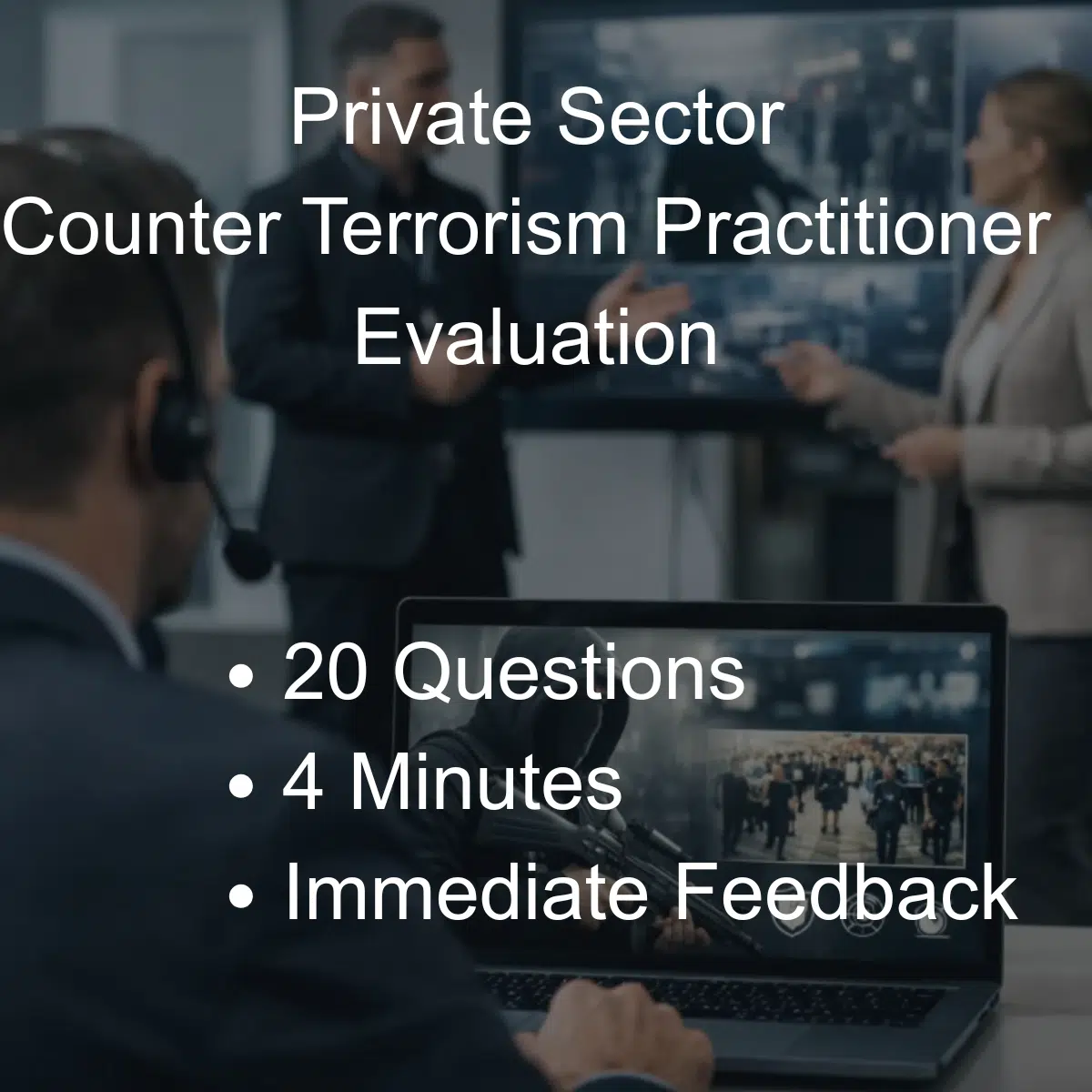
For dedicated practitioners, the requirement goes further again. They need diagnostic learning that exposes gaps in knowledge and application, then provides clear educational feedback. This is where evaluation platforms add real value. A capability diagnostic is more useful than a pass mark alone because it shows where performance is strong, where it is weak, and where development effort should be focused.
This approach is far more useful than generic completion metrics. It gives organisations a sharper picture of readiness across individuals, teams and functions. It also supports a more intelligent training plan, especially where budgets and time are limited.
eLearning is not a shortcut – it is a force multiplier
There is a common mistake in the market. Some buyers treat eLearning as the low-cost substitute for serious security development. That is the wrong lens. Well-designed digital learning is not a shortcut. It is a force multiplier.
It allows organisations to establish a consistent baseline across multiple sites, onboard new starters quickly, refresh knowledge without major disruption, and support role-specific development at scale. It also creates a repeatable way to assess whether learning is actually landing.
That said, it depends on what the organisation needs. If a site has complex threat exposure, major event risk, VIP presence or layered stakeholder responsibilities, eLearning should sit within a broader capability model. Digital learning is highly effective for awareness, diagnostics, reinforcement and structured development. It is less effective if used in isolation where site-specific planning, live exercising or detailed security design are required.
The strongest organisations understand that blend. They use eLearning to create informed people and measurable standards, then support it with consultancy, assessment and practical improvement work where the risk profile demands it.
How to choose private sector counter terrorism 21st century eLearning solutions
Buyers should start with one hard question: will this improve performance under pressure? If the answer is vague, the product is probably too generic.
Look for content built around realistic operating environments rather than broad public messaging. Check whether the learning is role-sensitive, whether it gives immediate educational feedback, and whether it can support capability measurement over time. Ask yourself how it addresses judgement, not just recall. Ask what the organisation will know after completion that it did not know before.
It is also worth examining credibility. Counter terrorism learning for the private sector should be shaped by real protective security experience, not recycled compliance language. Operational realism matters because learners spot superficial content quickly. Once confidence in the material drops, engagement usually drops with it.
Another useful test is whether the solution supports action after the course ends. Can results identify team-wide gaps? Can managers see patterns in understanding? Can the output inform planning, supervision, or further development? If not, the training may be too detached from the real job.
Mildot Group’s approach reflects this capability-first model – using accredited eLearning, evaluation and advisory support to turn theory into action and reduce real-world risks.
Where modern eLearning creates the biggest gains
The biggest gains usually appear in three areas. The first is consistency. Organisations with multiple locations or mixed teams need a common understanding of threat indicators, escalation routes and expected behaviour. The second is confidence. People who have worked through realistic scenarios are more likely to act early and report well. The third is visibility. Leaders gain a clearer picture of where capability is holding and where it is fragile.
This is especially valuable in sectors where turnover, agency staffing or seasonal surges create uneven experience levels. eLearning can close those gaps faster than traditional methods alone. It can also support professional development for practitioners who need more than basic awareness and want structured growth in protective security and counter terrorism competence.
The trade-off is straightforward. eLearning is scalable, measurable and efficient, but its impact depends on design quality and how seriously the organisation uses the results. If it becomes a box-ticking exercise, it will produce box-ticking outcomes. If it is treated as part of operational readiness, it can materially strengthen resilience.
Capability is the real outcome
Modern threats expose old security thinking. The private sector does not need more generic content. It needs training that sharpens observation, improves decisions, strengthens reporting and gives leaders a truthful picture of readiness.
That is the real promise of private sector counter terrorism 21st century eLearning solutions. Not convenience for its own sake, but practical capability that stands up when the pressure is real. If your training cannot change behaviour on a difficult day, it is time to expect more from it.
Useful Links:
.