Behavioural Observation Training for Security Teams
.
It is the middle of a busy afternoon. Hundreds of people are moving through the entrance to a large commercial building. Some are talking, checking their phones, carrying bags or looking for directions.
A security officer watches the flow. Nothing appears obviously wrong, but one person catches their attention.
There is no suspicious bag. No threatening behaviour. Nothing that clearly justifies intervention.
But something does not fit.
This is where the officer’s capability is tested.
Do they recognise something that deserves attention, dismiss it because there is no obvious threat, or allow an assumption to influence what they think they are seeing?
And if they do recognise something, what happens next?
That is the difference between simply watching an environment and being capable of observing it. The officer must recognise significance, make a credible decision and, where necessary, communicate clearly enough for somebody else to understand and act.
In a busy security environment, those few moments can matter.
.
Looking Is Not the Same as Observing
Security personnel spend much of their working day looking at people and environments. They patrol buildings, monitor entrances, watch CCTV and interact with the public. During a single shift, they may see thousands of people and hundreds of different behaviours.
Back at the entrance, people stop, change direction, wait for others, look around or move quickly through the crowd. Almost all of it is normal.
That is what makes effective observation difficult. Behaviour that matters does not necessarily announce itself. It sits amongst everything else happening in the environment.
The capability is not simply seeing more. It is recognising what matters.
.
Be Vigilant Is an Instruction. It Is Not a Skill.
Security personnel are regularly told to remain alert, maintain awareness and report suspicious behaviour. The intention is right, but telling somebody to be vigilant does not give them the capability to do it.
Without developed skills, vigilance can become little more than watching and waiting for something obvious to happen. By then, the opportunity for earlier recognition may have passed.
Security teams need to make sense of what they see, decide what matters and communicate useful information when it does.
.
Behaviour Without Context Can Mislead
The person at the entrance is still not doing anything that can simply be labelled suspicious.
Someone may appear nervous because they are late for an interview, look around because they are trying to find somebody or change direction because they are lost.
Remove the context and ordinary behaviour can be misinterpreted. Equally, behaviour that appears unimportant on its own may become significant when considered alongside what else is happening.
The objective is not to create suspicion. It is to improve judgement.
.
The Observer Matters Too
The human brain constantly filters information. Experience, expectations, distractions and assumptions can influence what attracts attention and how it is interpreted.
Someone who looks unusual may attract unnecessary attention, while important behaviour may be overlooked because the person appears completely ordinary.
For a security manager, this raises a simple question: if ten officers watched the same environment, would they all recognise the same developing concern?
If capability depends mainly on individual instinct, the answer may depend on who happens to be working.
That is not a reliable security capability.
.
An Observation Has to Lead Somewhere
Back at the entrance, the officer decides the behaviour deserves more attention. Now they must decide what happens next.
Continue observing? Inform another officer? Contact CCTV? Escalate?
The response should be proportionate to what has actually been observed. Then comes another critical capability: communication.
Saying “there is a suspicious person near the entrance” provides little useful information. What was actually observed? Where is the person? Why does it matter?
A good observation can quickly lose its value through poor communication. Clear, concise information allows others to understand what has been seen and make informed decisions.
Observation identifies. Judgement decides. Communication enables action.
.
One Officer May Only See Part of the Picture
Other officers are working across the building. Another is positioned at a different entrance and a CCTV operator has a wider view. Each sees a different part of what is happening.
One observation may mean little on its own. Combined with information from elsewhere, its significance may change.
This is where individual awareness becomes team capability. Developing a consistent ability to observe, decide and communicate reduces reliance on one particularly experienced or naturally observant officer.
Otherwise, capability can change every time the shift changes.
.
Where This Supports Martyn’s Law
These capabilities also have direct relevance to Martyn’s Law.
Current Home Office statutory guidance identifies monitoring as a public protection measure for enhanced duty premises and qualifying events. It describes relevant staff identifying, observing and reporting, or acting on, suspicious activity, items and behaviour. Importantly, it also highlights knowing what to report, who to report it to and how quickly.
CCTV, procedures and reporting systems can support this, but people still need the capability to use them effectively. For organisations developing their Martyn’s Law capability, behavioural observation can strengthen the human element behind monitoring, decision making and reporting.
.
The Advantage Is Earlier Recognition
Security problems become easier to identify once they are obvious. An alarm activates, somebody reports an incident or behaviour develops to the point where action is unavoidable.
By then, the situation has already moved forward.
Behavioural observation creates an opportunity for earlier recognition, while there may still be time to understand what is developing, communicate it and make a considered decision.
Most unusual behaviour will not indicate a threat. The value lies in recognising the occasions when something deserves attention before it becomes obvious to everyone else.
.
What Should Behavioural Observation Training Achieve?
Behavioural observation training should not make people suspicious of everyone around them or rely on simplistic lists of supposedly suspicious behaviours.
It should develop better observers and decision makers who can apply those skills in real environments.
For security personnel, the test is straightforward. Can they use what they have learned while monitoring an entrance, patrolling a public space, interacting with people or watching CCTV?
Knowing about situational awareness is not the same as being situationally aware.
.
Back at the Entrance
Hundreds of people have now passed through. Nothing dramatic has happened.
But one person behaved differently enough to attract attention. The officer recognised it, made a proportionate decision and communicated useful information to the wider team.
Perhaps it turns out to be nothing. That does not make the observation wrong. Behavioural observation is not about predicting an incident every time something attracts attention. It is about recognising when something deserves further consideration and responding appropriately.
Security personnel cannot know which ordinary shift might contain the early indicators of a developing problem. They can improve their ability to recognise them.
Earlier recognition. Better decisions. Clearer communication. Faster action.
.
Develop Your Situational Awareness & Behavioural Observation Capability
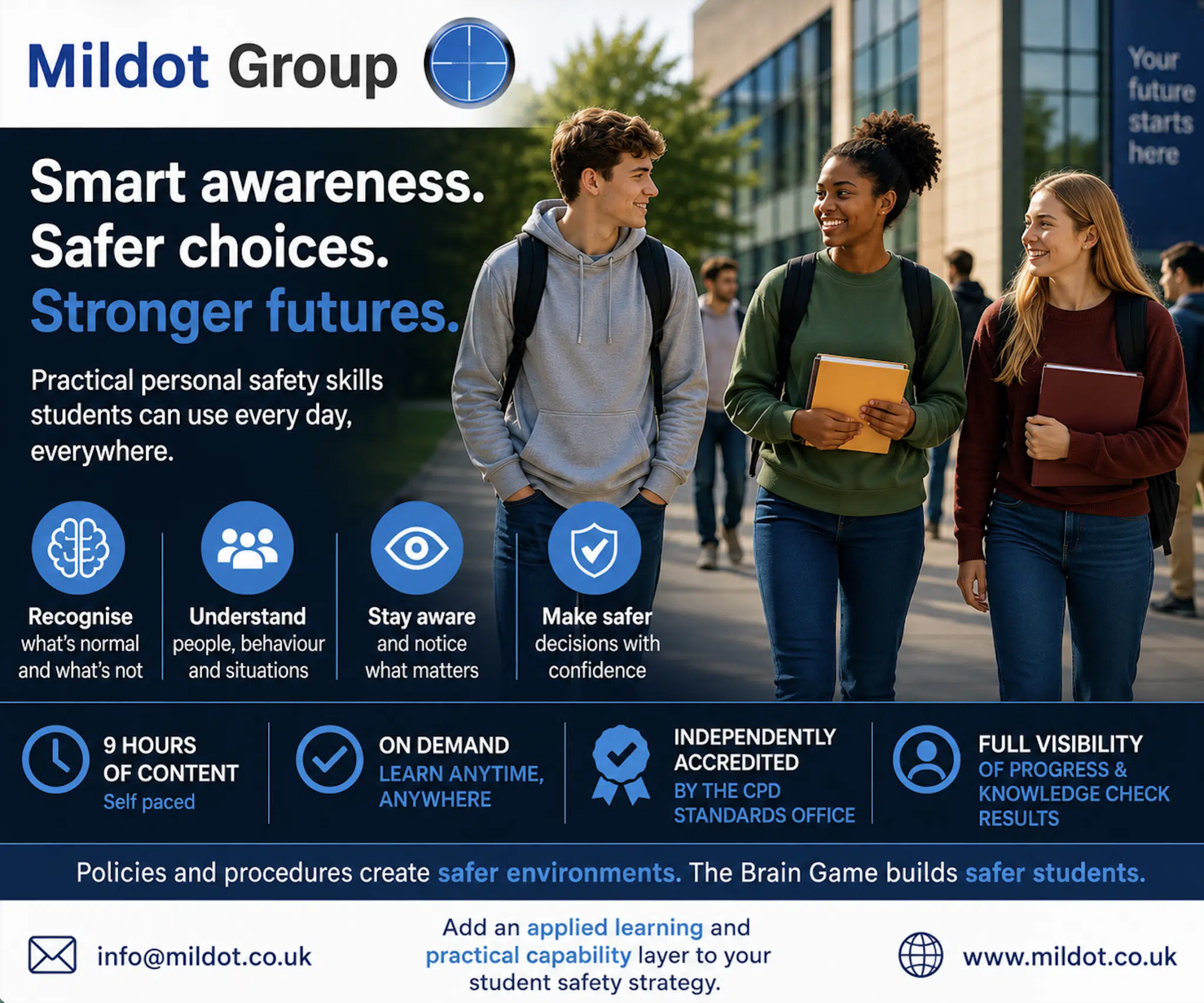
The Mildot Group Brain Game Situational Awareness & Behavioural Observation Programme is an accredited practical programme designed to develop awareness, observation, decision making and communication.
Rather than simply telling people to remain vigilant, it develops practical skills that can be applied in real environments and strengthened through continued use.
For security professionals and teams, the objective is greater capability to recognise what matters, make credible decisions, communicate clearly and act earlier.
The skills also extend beyond the workplace, supporting personal awareness and decision making in everyday life.
Individuals can complete the programme independently. Corporate & Group Accounts allow organisations to develop capability across security teams, control learner access and monitor progress.
Do not simply tell people to be vigilant. Develop their capability to do it.
.
Useful links:
.