A certificate still looks reassuring in a board pack. It does far less when a crowded venue faces a fast-moving threat, staff freeze under pressure, and decision-making collapses in the first minute. That gap explains why counter terrorism training trends are moving away from attendance, awareness and generic compliance towards capability that stands up in real operating conditions.
For security leaders, operations directors and risk teams, this change is not academic. Modern threats expose old security thinking. The organisations improving resilience are not simply training more people. They are training with more realism, measuring performance properly, and focusing on what staff and leaders can actually do when conditions are confused, noisy and time-critical.
Why counter terrorism training trends are changing
The pressure is coming from several directions at once. Threats remain varied, from low-sophistication attacks to more deliberate and adaptive hostile activity. Public-facing organisations are expected to prepare credibly, not just state that they take security seriously. In the UK, legal and regulatory expectations are sharpening that point, particularly for venues and operators reviewing their readiness under Martyn’s Law requirements.
At the same time, many businesses have learned a hard lesson from traditional training models. A once-a-year session, a slide deck, and a completion record may satisfy an internal process, but they do not necessarily improve recognition, reporting, command judgement or coordinated response. Training that looks tidy on paper can still leave dangerous gaps in behaviour, communication and leadership under stress.
That is why the strongest shift in the market is from knowledge transfer to performance development. Organisations want evidence that learning has changed behaviour. They want to know whether supervisors can make sound protective security decisions, whether front-of-house teams can spot pre-incident behaviours, and whether incident managers can work through ambiguity without delay or panic.
The move from awareness to measurable capability
One of the most important counter terrorism training trends is the decline of awareness-only programmes as the main answer. Awareness still matters. Staff need a baseline understanding of threat indicators, suspicious activity reporting, hostile reconnaissance and emergency actions. But awareness on its own is only the starting point.
The better programmes now test judgement, not just recall. They examine whether people can prioritise information, challenge assumptions and make proportionate decisions. That matters because incidents rarely present themselves in clean stages. Teams are often dealing with partial information, conflicting reports and operational friction. Training that never recreates those conditions gives a false sense of readiness.
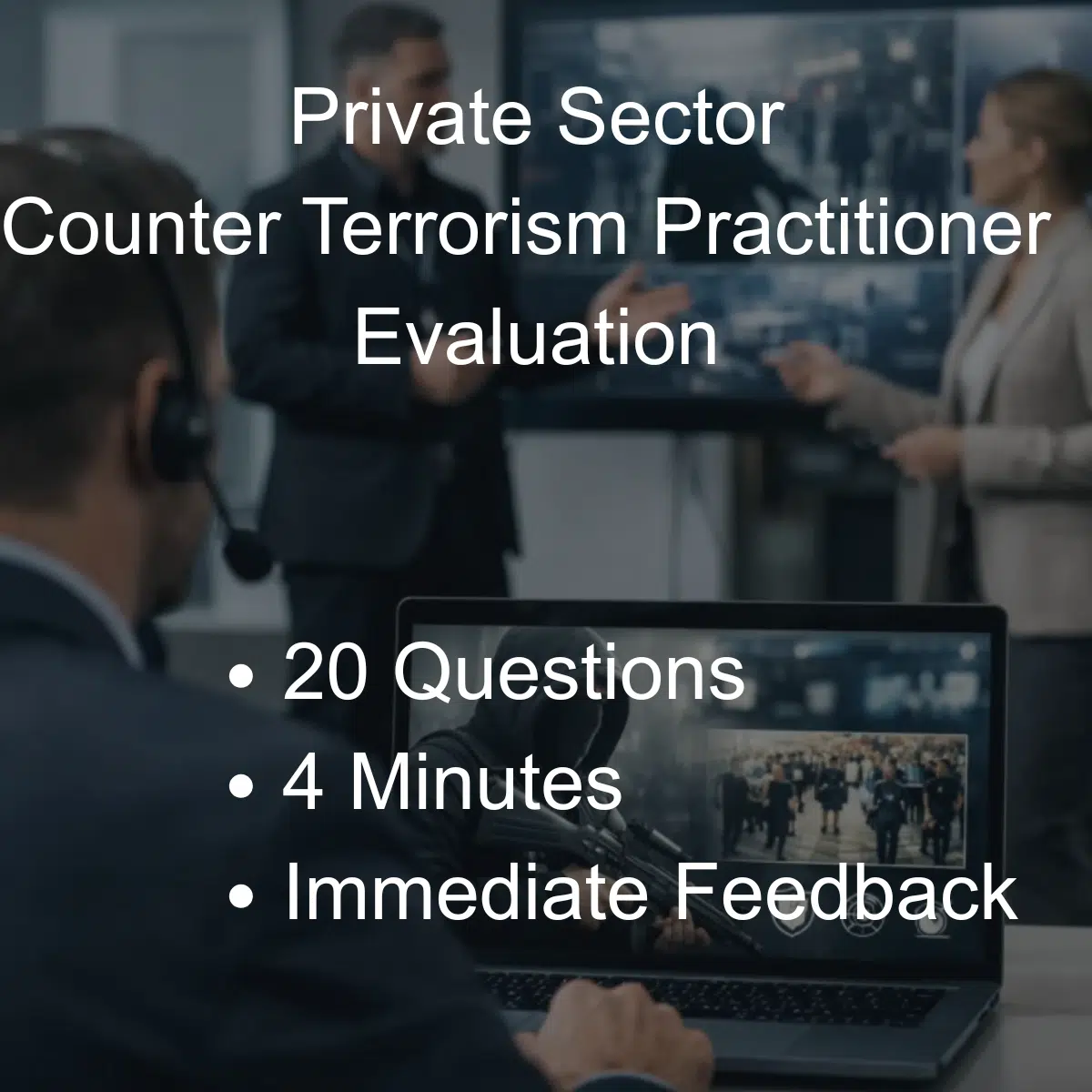
This is where assessments and capability diagnostics are becoming more valuable. Rather than asking whether a person completed a module, organisations are asking whether they demonstrated the right standard. Immediate feedback, benchmarked scoring and structured analysis are gaining ground because they show where competence is strong, where it is weak and what needs improving next. For many organisations, that is a far better use of time and budget than repeating the same awareness content every year.
Digital learning is growing up
E-learning is no longer treated as the cheap option. It is increasingly used as part of a layered development model, especially for dispersed teams, high staff turnover environments and organisations that need consistent standards across multiple sites.
The difference is quality and intent. Poor digital training remains poor training, whether it is online or in a classroom. The more credible platforms are scenario-based, operationally grounded and built around decision points rather than passive consumption. They help learners understand why certain actions matter, what good looks like and where mistakes typically occur.
For employers, digital delivery also offers something classroom-only approaches struggle to provide at scale – visibility. Completion data is useful, but performance data is much more useful. If a venue operator can see that teams consistently misunderstand search protocols, escalation thresholds or suspicious behaviour indicators that becomes a training issue that can be fixed before it becomes an incident issue.
Used properly, digital learning does not replace live exercising. It prepares people for it, reinforces it afterwards, and keeps capability moving between formal training events.
Scenario realism is replacing generic content
Generic counter terrorism training often fails for a simple reason. Staff do not see themselves in it. A retail team, a hotel operator, a stadium manager and an energy site supervisor face different operating realities, different public interactions and different vulnerabilities. If the training feels detached from the environment, engagement drops and retention follows.
This is why scenario realism has become central. Training is increasingly tailored to sector, site type, footfall, access control challenges, behavioural indicators and likely attack methodologies. That does not mean turning every course into an intelligence briefing. It means grounding learning in plausible situations that mirror the decisions people may genuinely face.
For public-facing sectors, that often includes suspicious item recognition, hostile reconnaissance indicators, queue and perimeter management, dynamic lockdown considerations, communications discipline and improvised evacuation choices. For leadership teams, the emphasis may be on command structure, competing priorities, information flow and business continuity under pressure.
The trade-off is that tailored training takes more thought than off-the-shelf compliance modules. It asks more from the provider and from the client. But it generally produces far stronger relevance, better uptake and more credible operational outcomes.
Behavioural performance is getting overdue attention
Another major shift is the recognition that technical knowledge alone does not decide outcomes. Behaviour does. Under pressure, people do not rise to a policy document. They fall back on habits, cues, confidence and team dynamics.
That is why stronger training programmes now include behavioural risk factors such as stress response, communication discipline, situational awareness, authority gradients and decision-making under uncertainty. These elements have often been ignored because they are harder to package neatly. Yet they are frequently the difference between a coordinated response and a fragmented one.
This matters particularly for supervisors, duty managers and operational leaders. They may know the plan perfectly well, but if they cannot process incomplete information, brief clearly, challenge poor assumptions or keep teams focused in the first critical minutes, the plan degrades quickly.
Organisations that invest here tend to gain more than terrorism preparedness alone. They also improve incident leadership, crisis communication and general resilience across a wider range of disruptive events.
Compliance is still part of the picture, but it is no longer enough
Compliance remains a driver, especially where legal duties and public accountability are increasing. But one of the clearest market changes is that serious buyers are becoming more sceptical of training built only to tick a box.
That is a healthy development. Compliance has value because it creates a floor. It sets minimum expectations, encourages consistency and can force overdue attention onto neglected risks. The problem starts when that floor is mistaken for operational readiness.
The better approach is to use compliance as a baseline and capability as the objective. In practice, that means linking training to site risk, role requirement and decision-making responsibility. A front-line customer-facing employee does not need the same depth as a protective security lead, and a board member needs a different level of understanding again. Training is becoming more role-specific because blunt one-size-fits-all delivery wastes time and leaves gaps.
Data-led improvement is shaping investment decisions
Security budgets are under pressure in many sectors, which means training has to justify itself. One consequence is that leaders are looking harder at evidence. What has improved? Where are the weak points? Which teams need support? What level of competence is acceptable for each role?
This is driving interest in evaluation tools, structured diagnostics and repeatable testing. They allow organisations to track progress over time rather than relying on anecdote. They also support more intelligent procurement. If an organisation knows where its vulnerabilities sit, it can invest in targeted development instead of buying broad training that feels reassuring but changes little.
For providers, this raises the bar. Good intentions are not enough. Training has to show operational value. Mildot Group’s approach reflects that shift by focusing on capability evaluation, immediate feedback and practical development that turns theory into action. That is where the market is heading – away from noise and towards evidence.
What buyers should watch for now
The current direction of travel is clear, but not every new offer is automatically better. Buyers should be cautious of training that uses modern language while still relying on passive delivery, vague outcomes and little measurement. A polished platform is not the same as credible learning design.
What matters is whether the training reflects real risk, tests judgement, improves behaviour and provides usable feedback. It should fit the operating environment, respect role differences and support continuous improvement rather than annual repetition for its own sake.
The strongest counter terrorism training trends are not really about format. They are about standards. Organisations are asking harder questions, and rightly so. If a programme cannot show how it improves readiness, it is probably only improving paperwork.
The useful test is simple. If your team had to act tomorrow, would your current training help them recognise the threat, communicate clearly and make sound decisions under pressure? If the answer is uncertain, that is where the next training conversation should start.
Apply for Mildot Group consultancy services
Our consultancy capacity is limited to ensure every organisation receives direct practitioner involvement, practical solutions, and support throughout the project.
Useful Links:
.