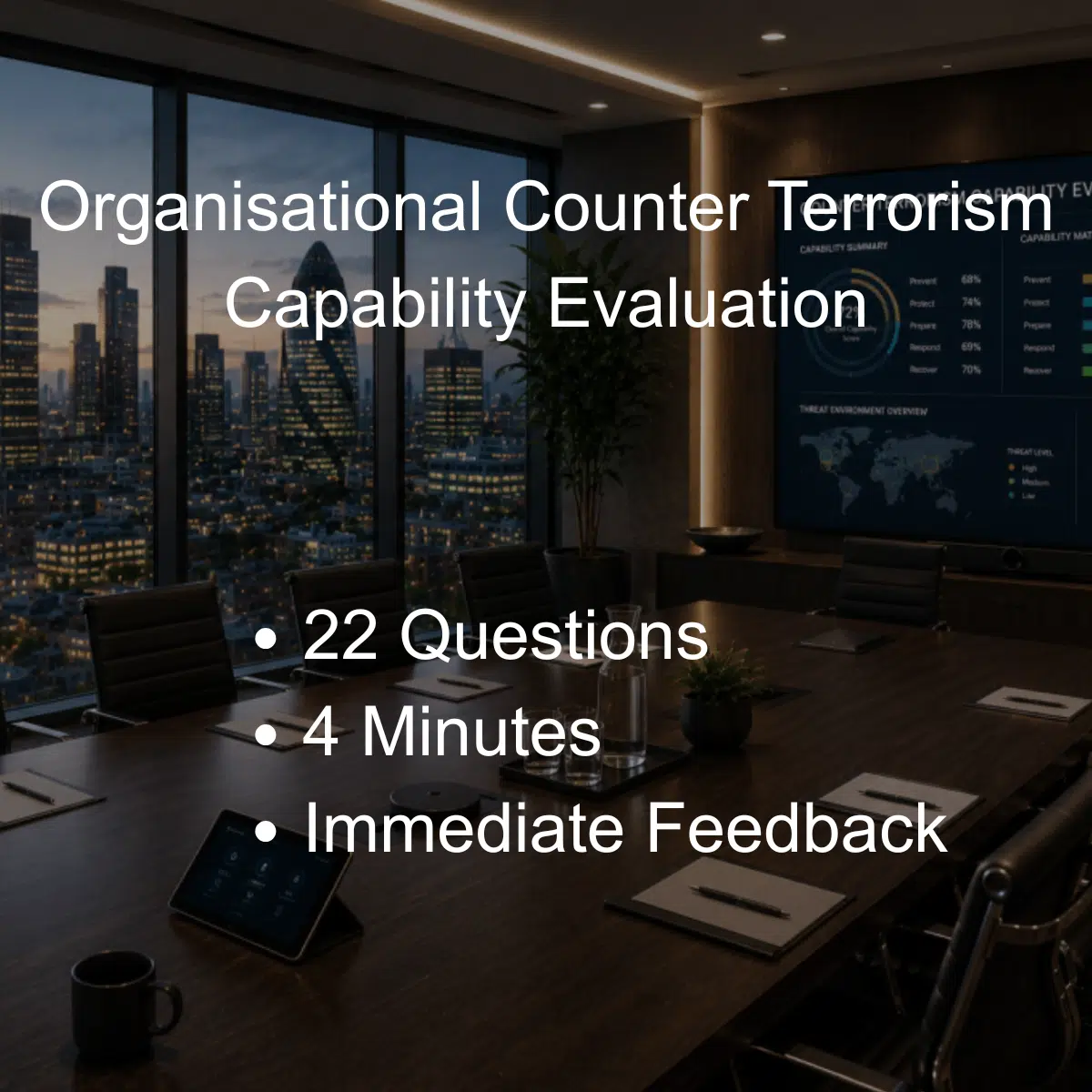
A counter terrorism plan can look tidy on paper and still fail under pressure. That is the gap an organisational counter terrorism capability evaluation with immediate feedback is designed to expose. For security leaders facing Martyn’s Law duties, crowded public environments, or high-consequence operational risk, the real question is not whether a policy exists. It is whether people, systems and decisions will hold when time compresses and uncertainty rises.
This is why capability evaluation matters. It moves the conversation away from broad assurances and towards evidence. Not theoretical compliance, but practical readiness. Not whether a team has read the guidance, but whether it can recognise a threat pattern, escalate correctly, make defensible decisions and recover control quickly.
What organisational counter terrorism capability evaluation is really measuring
An effective evaluation is not a box-ticking exercise dressed up as assurance. It is a structured test of how an organisation performs across the elements that shape protective security and counter terrorism readiness. That includes governance, planning, situational awareness, reporting pathways, incident decision-making, behavioural response, communication, coordination and post-incident learning.
The strongest assessments also look at competence by role. A board-level risk owner does not need the same knowledge depth as a site security manager or an operations lead, but all three need enough understanding to act decisively inside their lane. If one layer is weak, the whole system slows down.
That is where many organisations get caught out. They commission risk assessments, update procedures and deliver awareness briefings, then assume capability has improved. Sometimes it has. Sometimes the paperwork has simply become more detailed than the performance behind it.
Why immediate feedback changes the value of the exercise
Delayed reporting weakens learning. If a team completes an evaluation and waits days or weeks for high-level comments, much of the operational value is lost. Immediate feedback changes that. It gives individuals and organisations a live diagnostic of where they stand and what the result means.
That matters for two reasons. First, it sharpens recall. People understand why they answered incorrectly while the decision process is still fresh. Secondly, it accelerates improvement planning. Leaders can see where the capability gap sits – knowledge, judgement, role clarity, escalation, command confidence or broader organisational design.
In practice, immediate feedback turns evaluation into development. It stops the exercise being a passive scorecard and makes it an active learning tool. That is especially useful for large organisations with mixed levels of maturity, where some teams may be advanced and others are only just moving beyond baseline awareness.
Organisational counter terrorism capability evaluation with immediate feedback in practice
Used properly, an organisational counter terrorism capability evaluation with immediate feedback gives far more than a pass-fail result. It helps answer operational questions that matter.
Can managers identify the indicators that suggest hostile reconnaissance rather than routine customer behaviour? Do staff understand the difference between suspicious activity reporting and emergency escalation? Are control room personnel, venue leaders and senior decision-makers aligned on who owns what during a fast-moving incident? Does the organisation understand where confidence is justified and where it is assumed?
These are not academic concerns. In retail, hospitality, events and public-facing commercial environments, the speed of recognition and the quality of first decisions can shape the rest of the incident. Early hesitation, confused reporting lines or poor threat interpretation can waste the only clear window to act.
A credible evaluation also gives private sector protective security practitioners something many development programmes miss – an honest baseline. Experienced professionals do not improve through generic reassurance. They improve when strengths are confirmed, weak points are visible and the route to better performance is clear.
Where many capability programmes fall short
The common failure is to assess documents instead of capability. Policies, plans and training records matter, but they are not the same as operational readiness. An organisation can be well documented and badly prepared.
Another problem is over-reliance on generic awareness content. Broad counter terrorism messaging has value, especially for frontline staff, but it does not tell a security manager whether their team can interpret a developing picture, prioritise competing risks or maintain control when communications become fragmented.
There is also a trade-off between depth and scalability. Bespoke consultancy-led exercises can uncover nuanced issues that standard tools may miss. But they take time, senior engagement and budget. Digital evaluation platforms with immediate feedback offer speed, repeatability and wide reach. For many organisations, the best answer is not one or the other. It is a layered model where scalable diagnostics identify gaps and targeted consultancy addresses the highest-risk areas.
What good feedback should actually tell you
Feedback needs to do more than highlight incorrect responses. It should explain the capability issue behind the answer and point towards improvement. If a result shows weakness in threat recognition, the organisation needs to know whether the issue is lack of knowledge, unclear contextual understanding or poor role-specific training.
The same applies at leadership level. If a senior team scores well on strategic duties but underperforms in incident decision scenarios, that is a different problem from not understanding governance responsibilities. One requires sharper exercising and decision rehearsal. The other may require a more fundamental reset in ownership and accountability.
For that reason, the best evaluation outputs are educational as well as diagnostic. They build understanding while measuring competence. Mildot Group has positioned this approach well because it turns evaluation into practical improvement information rather than static reporting.
Who benefits most from this approach
Any organisation with public exposure, reputational sensitivity or legal preparedness obligations can benefit, but the gains are strongest where risk is dynamic and the margin for error is small. Event operators, hospitality groups, retail portfolios, transport-linked environments, critical infrastructure teams and high-profile commercial sites all face versions of the same problem. They need readiness that works at pace, across roles, and under pressure.
It is equally valuable for individual practitioners. Counter terrorism and protective security professionals often struggle to benchmark themselves honestly. Immediate-feedback evaluation gives them a way to test judgement, identify blind spots and direct professional development with more precision.
That said, results must be interpreted properly. A low score in one business unit does not always mean poor people. It may point to inconsistent training, unclear leadership signals or outdated local procedures. Capability is rarely just an individual issue. It is usually an organisational one.
How to use evaluation results without wasting them
The result should trigger action, not sit in a report folder. Start by separating urgent operational weaknesses from longer-term development needs. If the evaluation reveals confusion around incident escalation or suspicious activity response, that needs immediate correction. If it shows broader gaps in strategic security maturity, the response may involve a phased plan.
Then align the findings to role-specific development. Frontline teams may need sharper behavioural detection awareness and reporting confidence. Managers may need scenario-based decision practice. Senior leaders may need clearer governance, resourcing and assurance mechanisms.
Finally, repeat the process. Capability is not fixed. Threats evolve, staff turnover changes team competence, and old assumptions quickly age. Re-evaluation matters because improvement that is not measured tends to drift.
The commercial case for evaluating capability properly
For many leaders, the barrier is not understanding the need. It is competing priorities. Security teams are expected to strengthen preparedness while budgets, operational tempo and board attention move elsewhere.
This is where immediate-feedback evaluation has a clear advantage. It is efficient, scalable and easier to justify because it produces usable insight quickly. It helps organisations focus resources where they will reduce real-world risks rather than where they simply look active.
It also supports more credible assurance conversations. Boards, insurers, partners and stakeholders are increasingly alert to the difference between policy ownership and actual readiness. An organisation that can demonstrate measured capability, identified gaps and active improvement is in a stronger position than one relying on broad statements of intent.
Modern threats expose old security thinking. If readiness is still being judged by document completion, annual training logs and assumption, there is a weakness in the system. Organisational counter terrorism capability evaluation with immediate feedback offers a more disciplined answer. It tests what matters, teaches while it measures, and helps turn security theory into action. The useful question now is not whether evaluation is necessary, but how quickly your organisation wants honest evidence of what will happen when pressure arrives.
Useful LInks:
.