A security plan can look impressive on paper and still fail in the first five minutes of pressure. People miss cues, fixate on the wrong threat, delay escalation, or revert to habit when the situation demands judgement. That is where behavioural risk consultancy matters. It focuses on how people actually think, decide and act when the stakes are high – not how policy assumes they will behave.
For organisations with elevated exposure, that distinction is not academic. It affects incident prevention, escalation speed, leadership under stress, team coordination and recovery after disruption. Whether the concern is hostile reconnaissance, insider threat, crowd pressure, lone actor violence, executive protection, or a wider counter terrorism posture, human behaviour sits at the centre of the risk picture.
Behavioural risk consultancy is about performance under pressure
At its core, behavioural risk consultancy examines the gap between stated process and real-world human performance. Most organisations already know their procedures. The problem is that procedures do not execute themselves. Frontline teams interpret them. Supervisors apply them. Leaders make trade-offs in imperfect conditions.
A useful consultancy engagement does not stop at awareness training or generic advice about culture. It looks at the conditions that shape behaviour. That includes workload, supervision, confidence, role clarity, environmental design, reporting pathways, training quality and the practical effects of stress.
This is why behavioural risk work often produces better outcomes than a compliance-only approach. Compliance tells you whether a process exists. Behavioural analysis helps you understand whether people will spot the trigger, trust the process, act quickly and coordinate effectively when it counts.
Where behavioural risk consultancy adds value
The strongest applications are usually found in environments where there is little time, high consequence and no room for hesitation. Retail, events, hospitality, transport, corporate estates, critical infrastructure and high-risk commercial operations all face this challenge in different ways.
In one setting, the issue may be staff normalising suspicious behaviour because they see it too often and stop treating it as unusual. In another, it may be senior managers creating delay because escalation thresholds are vague and nobody wants to make the wrong call. Elsewhere, teams may know the threat indicators but fail to share information across departments quickly enough to create a useful response.
Behavioural risk consultancy helps identify these weak points before they become operational failures. It can test whether a team recognises pre-incident indicators, whether a control room communicates clearly under pressure, whether supervisors challenge unsafe behaviour consistently, and whether decision-makers understand what good judgement looks like when information is incomplete.
That matters for counter terrorism readiness in particular. Modern threats expose old security thinking. A checklist may help with baseline standards, but it will not tell you how a receptionist responds to ambiguity, how an event manager handles conflicting reports, or how a venue team balances customer experience with protective security action. Those are behavioural problems, and they need operational answers.
Good consultancy looks beyond the individual
There is a common mistake in this area. Organisations assume behavioural risk sits mainly with the individual employee – poor choices, weak awareness, lack of vigilance. Sometimes that is true. More often, behaviour is shaped by the system around the person.
If reporting a concern is slow, staff will avoid it. If managers discourage challenge indirectly, concerns stay unspoken. If training is theoretical and detached from the site, people struggle to apply it. If exercises are too scripted, confidence looks stronger than it really is.
A credible behavioural risk consultancy will therefore look at both people and operating conditions. It will ask hard questions. Are staff expected to make security-critical decisions without practical rehearsal? Are supervisors equipped to coach judgement, or only enforce procedure? Do teams understand the difference between unusual behaviour and actionable concern? Is the physical environment making observation and intervention harder than it needs to be?
This system view is what turns behavioural work into risk reduction rather than a soft culture exercise. It is not about vague discussions of mindset. It is about creating the conditions for better decisions, faster escalation and more reliable action.
Behavioural risk consultancy and Martyn’s Law
For organisations preparing for Martyn’s Law, behavioural risk consultancy becomes especially relevant. The legislation raises the standard for preparedness, but legal compliance alone will not create effective capability. A venue can have plans, policies and designated responsibilities and still perform poorly if people are not ready to act under pressure.
That is the practical challenge. Preparedness is not just a documentation task. It is a capability task.
A behavioural lens helps organisations test whether training has translated into action. Can teams identify suspicious behaviour confidently without overreacting to routine activity? Do they know when to escalate, to whom, and with what information? Can leaders make timely decisions when an incident is still unclear? Can departments work together without confusion over authority and intent?
For many organisations, these are the real friction points. They sit between compliance and performance. They are often missed until an exercise exposes them – or a live incident does.
What to expect from a serious behavioural risk consultancy
A serious provider should not offer generic behavioural advice disconnected from operational reality. The work should be grounded in threat context, site function and role-specific decision-making.
That usually starts with assessment. Interviews, observation, document review, capability diagnostics and scenario-based testing can all help establish how the organisation performs now, not how it believes it performs. In the right hands, this reveals where the risk sits: awareness, communication, supervision, confidence, leadership, environmental design, or a combination of factors.
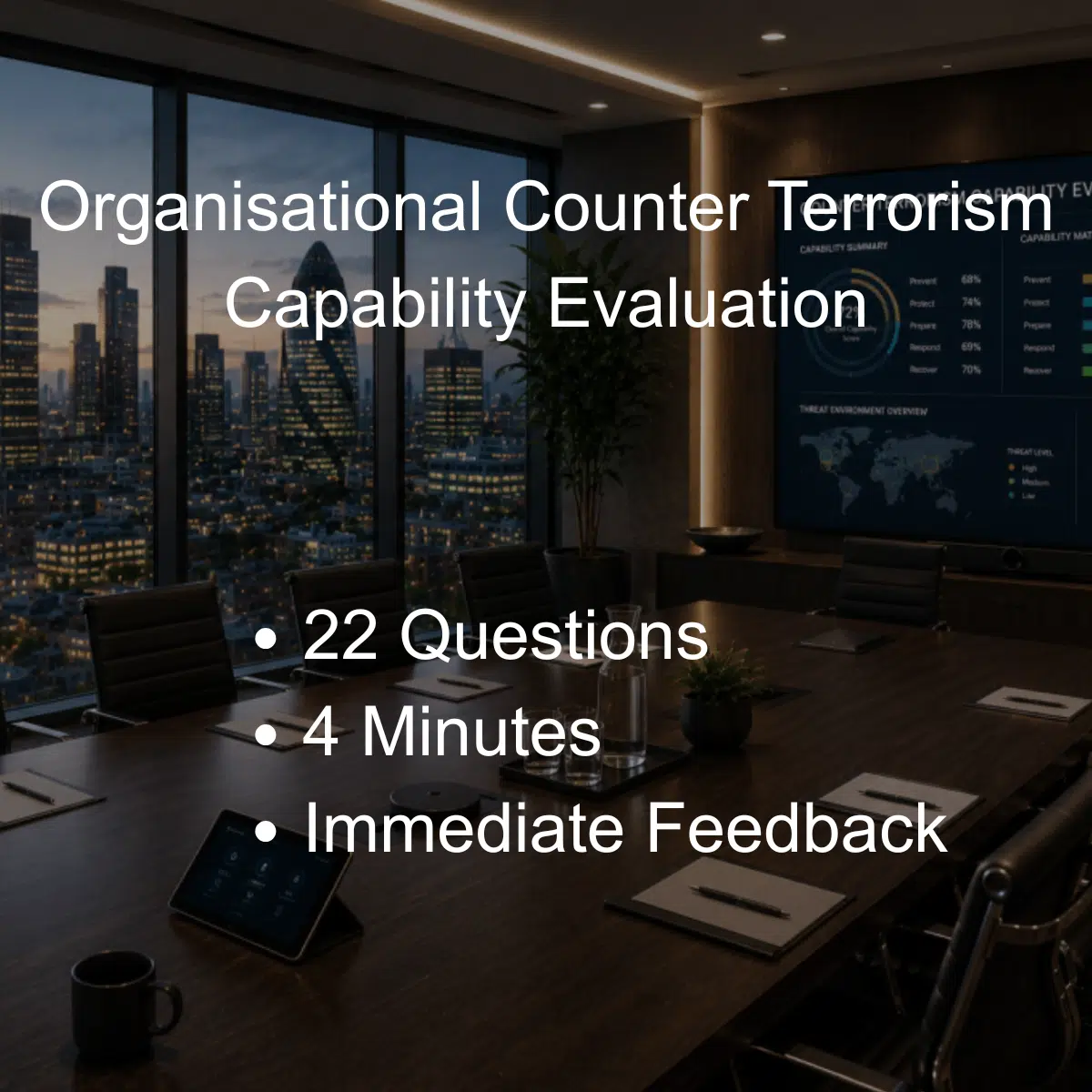
From there, the consultancy should translate findings into practical change. That may include refining escalation pathways, adjusting training content, improving incident decision tools, strengthening supervisory behaviours, or redesigning exercises to reflect realistic pressure. In some cases, digital learning and capability evaluation platforms add value because they give immediate feedback and expose inconsistent understanding across teams.
The best work is measurable. Not perfect, but measurable. Organisations should be able to see whether reporting quality has improved, whether decision times have reduced, whether teams are identifying relevant indicators more consistently, and whether exercises show stronger coordination than before.
Why generic advice often fails
Generic advice fails because it treats all organisations as if they face the same pressures. They do not.
A hotel balancing guest experience and suspicious activity management has different behavioural demands from a retail centre dealing with high footfall, or an infrastructure operator managing restricted zones and insider risk. Even within the same sector, site layout, staffing model, leadership maturity and threat exposure can change the answer.
This is why off-the-shelf behavioural content, on its own, rarely solves the problem. It may raise awareness, but awareness is only one layer. People also need context, repetition, practical relevance and leadership reinforcement. Without that, training becomes another annual requirement rather than a shift in performance.
That does not mean every organisation needs an expensive, complex programme. It means the response should fit the risk. Sometimes targeted consultancy, a clear capability assessment and role-specific development are enough to expose and address the main weaknesses. Sometimes the issue is deeper and needs wider organisational change. It depends on the threat profile, operational tempo and maturity of the team.
Choosing the right behavioural risk consultancy partner
The right partner will speak the language of operations, not just theory. That matters because behavioural risk in security settings is not an abstract human resources problem. It is a live operational issue with consequences for safety, continuity, reputation and legal exposure.
Look for evidence that the consultancy understands pressure, ambiguity and command judgement. Look for a method that connects behavioural insight with protective security, counter terrorism readiness and practical implementation. Look for recommendations that can be used by frontline teams and senior leaders alike.
Most of all, look for honesty. A credible provider should tell you where your capability is genuinely strong, where it is weak, and what improvement will require in time, effort and leadership attention. Anything less is reassurance, not consultancy.
Mildot Group approaches this space with that operational standard in mind. The aim is simple: turn theory into action and reduce real-world risks by improving how people and organisations perform when pressure strips away assumption.
Behavioural risk is rarely solved by telling people to be more aware. It is reduced when organisations design for better decisions, train for realistic pressure, and build capability that holds when conditions deteriorate.
Useful Links:
.