A vehicle does not need to enter an event site to create a serious problem.
It may be stopped outside a gate, approach through a service route, or cause disruption at a queue where people are concentrated and staff attention is elsewhere.
Protecting events from vehicle attacks is therefore not a matter of placing barriers at the front entrance. It is a planning and capability issue that begins with understanding how people, vehicles and decisions interact across the whole event footprint.
Too many event plans still treat hostile vehicle mitigation as a specialist engineering problem. Physical measures matter, but they do not compensate for a poor site assessment, confused responsibilities or staff who do not know what looks wrong and who has authority to act.
A barrier without a workable operating plan can move risk rather than reduce it.
Start with the event, not the product
The first question should not be, Which barriers do we need? It should be, What are we trying to protect, from what, and during which phases of the event?
The answer will differ for a ticketed arena show, a town-centre festival, a sports fixture, a conference venue or a seasonal market.
Consider the full lifecycle. Build and breakdown often introduce more vehicle movements, more temporary staff and less controlled access than the live event itself. Arrival and departure may create queues beyond the formal boundary. Nearby roads, loading areas, drop-off points and pedestrian routes can all affect exposure.
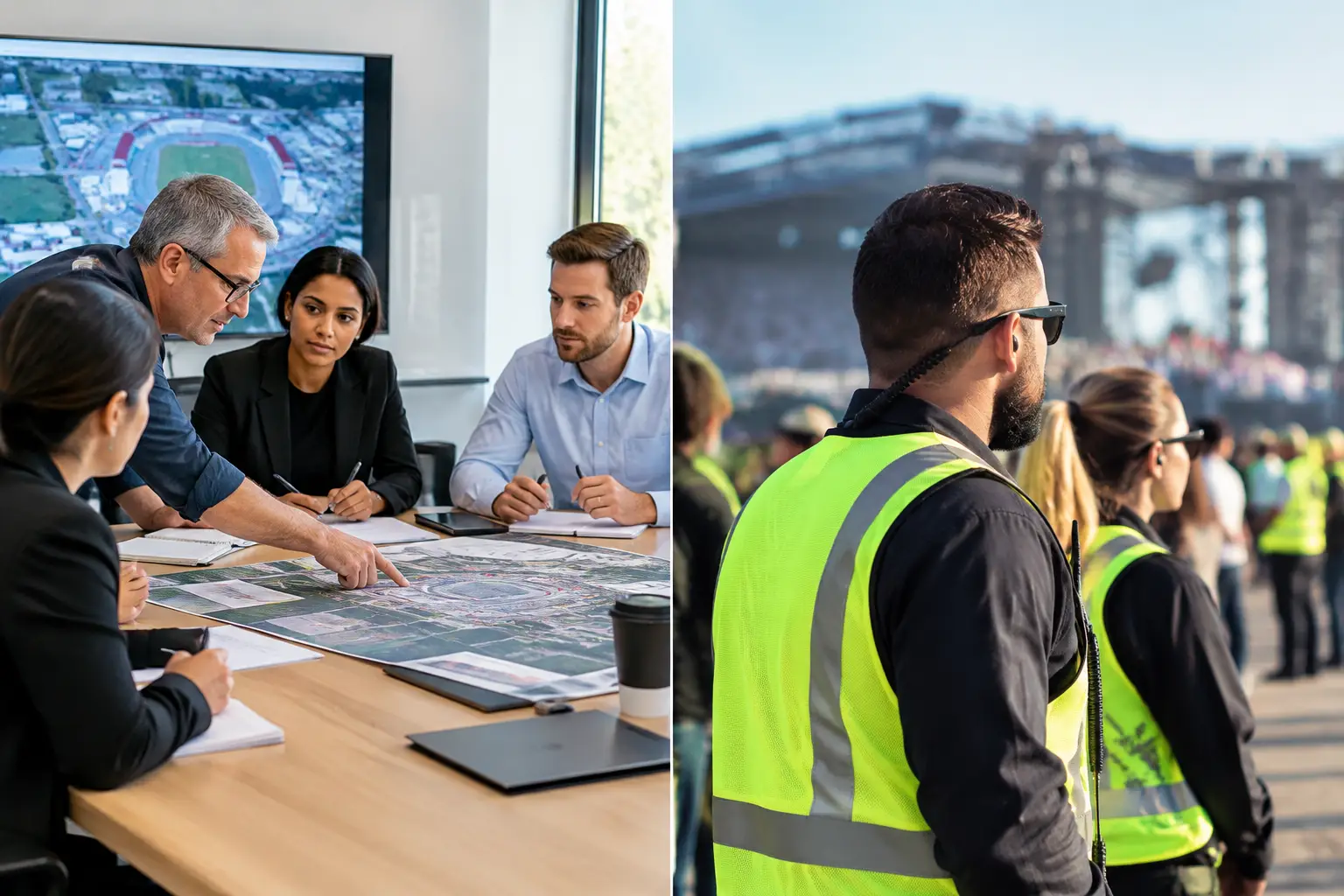
A credible threat, vulnerability and risk assessment should identify where people gather, where vehicles have legitimate reasons to be present, and where the two come into avoidable conflict. It should also examine what is already in place. Permanent street furniture, existing access controls, stewarding arrangements, venue rules and local traffic management may contribute to the solution, but only if they are understood and coordinated.
The uncomfortable reality is that a generic plan copied from a previous event often misses the conditions that make this event different.
A new layout, altered road works, a revised gate position, a larger audience or a change in public transport can materially change the risk picture.
Protecting events from vehicle attacks means managing interfaces
The critical points are usually interfaces, where a vehicle enters a managed area, where staff hand responsibility to another team, or where members of the public cross from an open space into a controlled one.
These are operational issues as much as physical-security issues.
Vehicle access should have a clear purpose. Organisers need to know which vehicles are expected, when they are expected and where they can go. That does not mean creating a slow, bureaucratic process that frustrates contractors.
It means making legitimate activity distinguishable from activity that is unexplained, poorly timed or inconsistent with the agreed plan.
Access arrangements also need to work when the plan is under pressure. A late delivery, a contractor demanding entry, a queue building at a gate or an emergency service request can all produce hurried decisions. If the only instruction is ‘use judgement’, the organisation has passed a critical security decision to someone who may not have the information, authority or confidence to make it.
Good planning gives teams practical decision boundaries. Staff should understand who can approve exceptions, how concerns are raised, and what happens if access cannot be granted immediately. This is not about turning every steward into a security specialist.
It is about ensuring the right person can recognise a concern, communicate it accurately and act without unnecessary delay.
Physical measures must fit the operating reality
Hostile vehicle mitigation measures need to be proportionate, suitable for the location and integrated with event operations. The most imposing solution is not automatically the best one.
A measure that blocks emergency access, creates unmanaged crowd pressure or cannot be deployed correctly by the available team may introduce new problems.
Temporary measures are particularly dependent on competent installation, inspection and management. They should not be treated as equipment that can simply be hired, placed and forgotten. Their location, condition, operational status and effect on access routes need checking before opening and throughout periods of change.
Permanent measures can be valuable where a venue or public space hosts repeated events, but they still require an operating concept. Consider deliveries, waste collection, accessibility, emergency response and the needs of neighbouring businesses. Security design that ignores how a place actually functions rarely remains effective for long.
There is also a tendency to focus heavily on the main entrance because it is visible and easy to explain. The more difficult work is assessing secondary routes, service areas and edge conditions where control may be weaker.
That assessment should remain proportionate. Not every route requires the same treatment, but every route needs a conscious decision rather than an assumption.
Capability is the control that paperwork cannot provide
An event security plan may describe escalation procedures perfectly and still fail at the moment a member of staff notices an unexpected vehicle or an abnormal change in behaviour. The difference is capability: whether people can interpret what they see, remain composed, communicate clearly and make decisions within their role.
Training should reflect the environment people will work in.
A team needs more than awareness of a threat category. They need to understand their own site, the normal pattern of activity, the reporting route and the practical consequence of delaying a decision. Scenario-based discussion is useful when it tests judgement rather than rewards people for repeating expected answers.
Supervisors deserve particular attention. They are often the people asked to resolve competing pressures from operations, contractors, visitors and senior management. If they are unclear about priorities, security controls are likely to be relaxed informally.
Clear leadership makes it easier for staff to challenge unusual activity without feeling they are obstructing the event.
Mildot Group’s experience is that capability assessments can reveal gaps that attendance records do not. A completed course confirms participation. It does not necessarily show whether an individual can apply learning to a busy, ambiguous situation. Organisations should be willing to test understanding, give immediate feedback and target development where it is needed.
Rehearse decisions, not just incidents
Exercises often become theatrical. They concentrate on the incident after it has fully developed, while overlooking the earlier decisions that may have prevented escalation or reduced harm. For vehicle-related threats, rehearsal should include the awkward moments: an unclear request for access, a change in traffic flow, a report that cannot be verified quickly, or disagreement between an event manager and security lead.
The aim is not to create fear or demand perfection. It is to expose uncertainty before the event opens. Can staff contact the right person? Does that person have current information? Is there a shared understanding of who can pause access, redirect people or request support?
If the answer depends on an individual being available, the arrangement is fragile.
Post-event reviews should be equally honest. Ask where controls were bypassed, where queues formed unexpectedly, what decisions took too long and what staff found difficult. Near misses and operational friction are valuable evidence.
They show where the written plan did not match reality.
Avoid security theatre
Visible measures can reassure audiences and stakeholders, but visibility is not the same as effectiveness.
A highly visible control that is inconsistently managed may create false confidence.
Conversely, a well-designed arrangement may look ordinary because it is built into the way the event operates.
The test is straightforward: does the measure reduce a defined vulnerability, and can the organisation sustain it for the duration of the event?
If neither answer is clear, reconsider it. Security must support safe, workable operations, not become a display of activity.
For organisations preparing under Martyn’s Law, this distinction matters. Compliance activity may prompt useful planning, but the practical standard should be higher than having documents available for inspection. Leaders need confidence that their teams can identify emerging concerns, apply controls consistently and recover when conditions change.
A well protected event is not one with the most equipment or the thickest plan.
It is one where the site design, operating procedures and human judgement support each other.
The useful question for any organiser is this, if something unfamiliar happens at the edge of our event, will our people know what good looks like, who decides and what to do next?
.
Useful Links:
.